Monday, August 15, 2011

The Best Spooks Characters of All Time.

Sorry. I just can't help myself. The show is addicting and I have yet more to say about it. At some point I know I will move on in my tastes to something else, but right now it is all "Spooks" (that is "MI-5" for you less Anglophilic Americans). I'm sure that, in theory, there are other things worth doing. . . I know the iguana cage could use a cleaning. . . .  But right now that will have to wait.

Maybe it is irresponsible to keep trying to convince people to watch this show given that it gets into your brain like a worm and takes over?

. . . but I'm not ready to stop trying so I'll plunge forward with my list. There have been 9 complete seasons of this program, and I count 21 spooks who have graced the grid with their presence (so far). Check out the complete list here.  I am not including minor characters, recurring Americans or other bad guys (wink), or home secretaries, just the main team members who have worked to save the world.  And, when I say "best", I'm thinking of both: (1) the characters that enrich the program the most, without whom the show would suffer the greatest loss and (2) the ones that make the most skilled and useful spies - those you would definitely want on your side.
  1. Harry Pearce - His steadiness, consistency and surefootedness make him indispensable and I am so glad that he has never left or been killed off, though he's come close many times. Though he is usually seen indoors, my most memorable spy moments over the course of the show are when Harry gets out into the world and shows how calculating and on top of his game he really is (such as when he coolly takes off his tie and kills the bad guy tracking him or goes to the home of the former (and evil) home secretary and brazenly poisons him before removing the evidence and quietly leaving. He is equally competent with elected high-officials, walking political tightropes with ease and guts. I can't imagine Spooks without Harry, so he has to be #1. 
  2. Ruth Evershed - Ruth is the soul of the show. I like the show so much better when she is there.
    And this is in part because of Ruth herself, and in part because of how Harry becomes better and more interesting when she is around. She represents humanity. She reacts in horror when someone should react in horror. Although tough and battle-scarred she is absolutely touchable. Her strength is her analytical brilliance, paging through mountains of minutia to find some indispensable clue. It is so cool to see that valued! I wish like crazy I could find a job just like Ruth's -- only that didn't involve terror and death. (If anyone hears of anything. . . ) 
  3. Ros Myers - Of all the section chiefs, she is the best. Her motives and actions are
    unimpeachable. Solid and skilled, she is beyond tough and fearless. Despite what people say, she is not an ice queen. She cares deeply about her country and is willing to give everything she has to it without question. She is an untouchable. She is not perfect. Her judgement may sometimes fail, but her honor is unimpeachable. I don't need to be her friend, but I would always want her as my ally.
  4. Tom Quinn - It is really hard to choose between our three main men: Tom, Lucas and Adam. All three are equally tough and skilled spies with incredible energy and excitement generated around them. As people, they are all a bit screwed up, so they are on fairly equal footing. But, I'm giving the thinnest edge to Tom, because of his depth. He is introspective and serious. He is philosophical but still very real. He is in good touch with his own failings and knows he's walking on ice a lot of the time.  He approaches his work with great intellect. Although Lucas has a lot of these same qualities too, it turns out he has Voldemort growing out of the back of his head. . . .
  5. Lucas North. If Lucas hadn't turned out to be such a messed up example of humanity, I would
    probably have him a couple of notches further up on the scale. I adore his focus and his vague strangeness that makes him hard to know. It ideally suits a spy. But I don't like the back story that ended up tormenting his final episodes on the show. They proved little else than that Richard Armitage is a great actor and that even an amazing show like Spooks can have times when it's grasping at straws. But Lucas, in Seasons 7 through 9.6 is an amazing spy who would be giving Ros a run for her money at #3.
  6. Adam Carter. I really like his confidence and skill. He makes a great lead officer. He has a regular guy-ness about him which is very appealing. He also has a lot of emotional issues, but even through those, he manages to woo the women, catch the bad guys, strut around the office and give off a great air of "I'm in charge here." He is excellent at seeing another perspective and hunting out a less than obvious solution to a problem. I love Adam, but in the long run, its Tom and Lucas I miss.
  7. Zafar Younis. Zaf is extraordinarily skilled and confident. He somehow manages to be polite
    and kind to people and, unlike all those prima donna section chiefs, and is never pouty or irritable. Though he is less experienced, he acts with the confidence and skill of any senior officer. He is an incredible fighter with great energy and spirit and has to be one of the most fearless agents -- always getting sent undercover to the least appealing operations. Had he not died I would definitely have expected him to become section chief. I love his look, which for some strange reason reminds me of Ringo Starr, and which is open, guileless and friendly. He is not only good at what he does, he has great charm.
  8. Jo Portman. She is just freakin' adorable. (They haven't yet found a bad haircut for that girl; she rocks 'em all. Just sayin). In any case she is also a shockingly willing spy. For someone so young and relatively inexperienced, she goes into any situation under any circumstance and rises to the occasion. She also seems very human and appealing as a friend and confidant.
  9. Malcolm Wynn Jones. I love all the tech guys: Malcolm, Colin and Tariq. I'm giving the top spot to Malcolm only because, due to his experience and seniority, feels like more than just a techie. He is a more well-rounded presence on the grid. Plus its really cool to see someone his age get into all the gadgets.
  10. Colin Wells. A great open earnest lovely man. He manages to make computers funny.


Honorable Mentions: to Tariq Masood and Ben Kaplan. Really great appealing characters who just don't get the same opportunity to show their stuff as the 10 above do.


Honorable Mentions Class II: to Beth and Dimitri. Beth showed a lot of potential and by the end of Season 9, I really got to like her with Dimitri and them both with Lucas. Dimitri seems cut in the Zaf mode, so he has a lot of potential which I'm looking forward to seeing unfold. But there's just no way they can unseat any of the massive spooks on my top 10 list.


Least Favorites
  • Zoe & 
  • Danny. Both have too much angst and wishy-washiness. They seem so hesitant, afraid of their jobs and responsibility. There are times both become distinctly likable -- but those are few and far between. Though, in Danny's last episode he stepped up his game and definitely redeemed himself.
  • Fiona just irritates me. I feel like she's playing a part and too self-aware.
  • Tessa is another one that is just irritating. She's supposed to be all bad and corrupt, but she just comes off as totally forgettable. You want bad and corrupt, try Connie James. That's what I'm talking about.
  • Sam Buxton - the Scottish gal. Great voice.

Most medium (!)
All I have left is Helen and Connie. Connie is a played by the wonderful actress Gemma Jones. You love Connie and then you hate her. She is an interesting and thought-provoking person. Her final appearance in "Rain From Heaven" is an amazing part of the coolest episode ever. But I just can't say she is a "favorite" spook, so she gets stuck down here.

Helen. The main thing she is known for is her horrific death, setting the tone for this ruthless tv series early on, so, in that sense, she is important. I can't say she is particularly memorable; she was just beginning and the show was just beginning when she got removed from the squad in this terrible way. Don't hate her, don't love her; don't have much to say about her.

I have also compiled a list of all the Spy Teams that have been on the show (and picked my favorites). You can see that here:  Ultimate Spooks'-Lovers Guide to Spy Teams

The Best British Period Drama of All Time

Because I am an idiot and was spending all my time thinking about what I was going to vote for, I missed my actual opportunity to vote in Anglophenia's poll of the Best British TV Drama of All Time.

It's just as well really, because I somehow failed to notice that the poll was for best TV Drama. My brain somehow read that as best "Period Drama". Wishful thinking I suppose. So, my ultimate choice, which I gave a lot of pointless thought to, was a period drama that is not a TV show but a movie!

However, since I stood ready to justify it to Anglophenia, I will justify it now to you. My thoroughly biased and unscientific decision about the best British period drama of all time: Gosford Park.

This will come as a surprise to anyone who knows how much I love Jane Austen. Why, when there are so many incredible Austen adaptations, would I not choose one of them? I think Gosford Park wins in large part for the reason that it is NOT an adaptation. Whereas Jane Austen adaptations (or any other literary adaptation) stands or falls in part on the merits of the book. Austen adaptations are brilliant because Austen was brilliant -- her work then molded and compressed and made to fit the modern audience and modern format that is either TV or film -- while Gosford Park is brilliant and whole entirely on its own strengths.

What I mean to say is that, written and produced as a period drama specifically for film, Gosford Park feels complete as the expression of an artistic vision brought perfectly to life as it was imagined.

When I think of something that is visually superb, evocative of a particular time period, impeccably acted, witty, fresh and beautifully directed and filmed, I cannot think of anything that, on the whole, outshines Gosford Park. Its social commentary, emotional pull and great character-driven plot provide layers of viewing interest. The juxtaposition of class structure on top of a clever murder mystery was a stroke of brilliance.

And the cast has to be one of the best assembled ensembles I've ever seen.  Anything with Maggie Smith AND Helen Mirren in it gets big time points. Claudie Blakely (also of He Knew He Was Right, Lark Rise to Candleford and the 2005 Pride and Prejudice film) is fast becoming one of my all time favorite British actresses. Her performances are always heartfelt, deep, earnest and likeable. And don't even get me started on Michael Gambon, Jeremy Northam and Clive Owen.

So there it is: the answer to the question that nobody asked!


"The Best British Period Drama of All Time." LostinBritishTV

Thursday, August 11, 2011

Spooks, One of the Best TV Shows I've Ever Known, Is Ending.

After ten years of entertaining us the British television program Spooks, known here as MI-5, will be ending its run, producer, Kudos, announced today. According to the website guardian.co.uk the show is being pulled by its producers - not by the BBC - while it is still very much on a high note in popularity and excitement. Its 10th and now last season will air in England this fall.  Heaven knows how long I'll have to wait for that last season to come to me in America, but, I will be waiting . . . with bated breath, because Spooks is just that kind of a show.

Spooks is a program that infects the mind and the spirit and does not leave the viewer be. I will miss the breathless tension and intensity when it is all over, but am at least thankful to know I will have endless hours of continuing amusement available to me by re-watching the episodes already aired.


It is the right decision. Almost all of the best characters that have come into focus have now left the series (think: Lucas, Ros, Jo, Adam, Tom) and what is left, and what has been simmering on the back burner for several seasons now, is Harry and Ruth. Their sweet and tentative relationship, so beautifully portrayed by Peter Firth and Nicola Walker, is reaching a peak and has nowhere else to go other than to resolve itself. I therefore read the conclusion of the series as absolute proof that, one way or another, Harry and Ruth will be moving forward -- whether that is together, or apart, or dead. Executive producer Jane Featherstone has suggested as much in her interview with the Guardian -- giving the definite impression that she feels that their storyline requires an ending now.

I'm glad she thinks so, because I've noticed a problem with long running TV shows...the inability to reach the kind of dramatic climax and resolution for ongoing characters (of the type that movie characters enjoy). While each episode of a TV show may bring plot  resolution in the length of an hour, ongoing characters are often forced to live in a limbo state.  Especially when ratings gold is hit with "will they, won't they" romances. It is wonderful that Kudos is attuned enough to attend to that situation.

Harry and Ruth should move on and they should be together. They should just do it and then get off screen quick. I hope with fervent hope that the writers give me (and the million or so other people that really care about Harry and Ruth) that resolution before they conclude this excellent program forever.

The end to a show like Spooks that has held our collective hearts in its hands for a very long time is a sad thing, but good thing. Kind of like raising a child. You know that if you've done your job right, they grow up well adjusted and then leave you. It IS sad, but is the right thing for them to do.
Spooks: Peter Firth as Harry Pearce

A few of my other recent posts on Spooks:

What Does Spooks Have in Common with Pride and Prejudice?
Lucas North, The Character that Pamela Ewing Dreamed
Harry and Ruth: One of the Best Couples of All Time 
Lets Get Real: Ros Myers is Amazing 

Tuesday, August 9, 2011

"He Knew He Was Right." Great Title for a Strange Dip into the Inner Workings of the Mind of an Otherwise Normal Man

"Some mysterious agent interferes with the affairs of a man and it drives him on and on and on until he doesn’t know where he’s going."
-Louis Trevelyan, He Knew He Was Right.
(SPOILER ALERT). He Knew He was Right is another very rich and beautiful BBC period drama, presenting what is truly a simple tale of Louis Trevelyan, a man so deeply entrenched in his point of view, that he is willing to follow it to its extreme despite the cost and without even trying to question whether it is worth it.

His wife, Emily, almost as stubborn, is single-mindedly insistant on her own course of action, eschewing her husband's worries and refusing to bend, though it ultimately means losing the custody of her beloved child and, ironically, living in disgrace.

Although this is, at its core, a study in psychology set within the real estate of the mind, neither of our lead characters is introspective at all; neither seems more than vaguely aware that they are trapped and being destroyed from within nor capable of changing course. They are willing to clash over the non-issue of her infidelity (was she/wasn't she getting it on with Colonel Osborne) despite the tremendous costs to them both. For him, in particular, those costs are staggering and include both his sanity and ultimately his life.

The central theme held my attention for a while, but eventually began to feel drawn out and ridiculous. These people's little problems just became stupid by the end of the story. And maybe that is the point Anthony Trollope was trying to make. (I don't know much about Trollope, who wrote and lived in the Victorian era, other than that he was a well-traveled, prolific writer who was popular in his own era.) Maybe he is a bit of a satirist? But this is an odd story to try and sell to a modern audience because it is just so implausible.

I am not saying that the theme of people adhering blindly to things that are destructive is implausible. Surely that flaw transcends time and place. And jealousy can be a great force driving people to extreme behavior. But I don't think this story is about Louis' jealousy so much as his sense of social order and propriety. I don't believe he got into this predicament by believing his wife was cheating, but rather, in worrying how her visits with the Colonel must look to outsiders. Social implications are still important today, but how many modern people would follow social propriety to the death? I would have more sympathy for him as a tragic hero if his pursuits were grander, or maybe just plain compelling. And maybe that is something that gets lost in translation between the Victorian mindset and that of my modern American individualism.

The machinations of people in their little lives are like the scurryings of ants. It is sometimes hard to get worked up over them. It might be good truth, but for me it did not make the best drama. The background stories of the victor and his silly attempts to court a variety of women including two sisters (played hilariously by Fenella Woolgar and Claudie Blakley), Anna Massey's touching bipolar performance as Miss Stanbury, and the story of Nora and her lovers were far more dramatically interesting to me than our stubborn lead characters.

Still, I enjoyed the distraction of this adaptation. I found the production beautiful, the costumes appropriate and gorgeous, and the acting fine. I don't fault the production for this main story's faltering; I think that my response is more rooted in the nature of what the author is trying to sell than in the adaptation not conveying that message well. Still, to be sure, I want to read the book and see whether the main storyline plays better on the page.

And I am very willing to own that my own life at the moment is coloring my response to HKHWR. People intentionally screwing up their lives and doing it with blinders on must feel so hollow in light of my own recent burdens of heavy humanity which remind me that even upstanding, strong, and well-lived lives are still just the scurryings of ants.

The Trevalans go an extra step by taking what is already small about humanity and making it absurd.


"He Knew He Was Right is Actually a Great Title for this Strange Dip into the Inner Workings of the Mind of an Otherwise Normal Man" LostinBritishTV.com

Sunday, August 7, 2011

The Five Best Things About Harry Potter and The Deathly Hallows.

A short time ago I posted my thoughts on Harry Potter and the Deathly Hallows, Part 2. After watching it a second time, I found a few more things to love, so I decided to update my list and make it an "even" Five Things I Loved About Harry Potter and the Deathly Hallows. The first three I already mentioned in Harry Potter and The Deathly Hallows is Excellent, but the Ending is A Little Disappointing

http://moviecarpet.com
1. Neville Longbottom became a god. Seriously, this kid gets some great moments and it means so much having seen where he came from in this series. So proud of Neville!


http://29.media.tumblr.com
 2. Alan Rickman demonstrates extraordinary acting talent. His gift is stunning. The voice, the timing, the emotion. I will never be able to think of Snape without seeing Rickman's performance in my head. His acting was magical. 

http://fuckyeahmcgonagall.tumblr.com
3. Professor McGonagall makes one excellent badass. Nuff said.
http://images.wikia.com/harrypotter/images
4. Michael Gambon redeemed himself completely as Dumbledore. So the thing is, Dumbledore, as written in the books, is a quirky, brilliant, light, sparkly, childlike, secretive, sweet and deep character. In the first two Harry Potter movies, I thought  Richard Harris was great at expressing these qualities. Michael Gambon is a fantastic actor, but when he took over the role in the third movie after the death of Harris, I don't think he really understood Dumbledore. I didn't like where he took him. In some scenes he was downright intense and angry -- something Dumbledore just isn't. Here, Gambon, in the sequence at Kings' Cross and in the pensieve, finally brings the kind of Dumbledore I've been longing for from him. 

http://www.ciaranhinds.eu
 5. Ciaran Hinds as Aberforth Dubledore. He so effectively suggested the sibling relationship between Aberforth and Albus, I was half convinced through most of the movie that Michael Gambon was playing both roles. Nice work.


http://content8.flixster.com
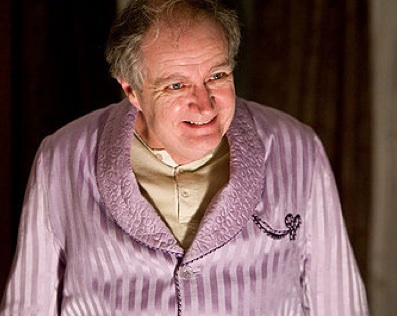
6. Jim Broadbent. OK, I know he only gets about 30 seconds of screen time in this  movie, but whenever he is in the field of view I am mesmerized. He makes Professor Slughorn one of my all time favorite Potter characters.
http://images.wikia.com/harrypotter/images
 
7. Just deserving a brief mention (yes, I see that I am up to 7 now; I am not very good at holding myself to my rules), is Helena Bonham Carter's Hermione on Polyjuice Potion as Belatrix. She was hilarious.
Unfortunately the ending of this movie is still a let down. From the beginning of the movie, up to about the point where Neville confronts Voldemort, this is a wonderful film, but then it just starts to feel disappointing. Too much attention is placed on powerful special effects and spectacle and the underlying human, er wizard, story gets lost.

I'm unhappy that Snape is never publicly vindicated. And that no one is around to witness Voldemort's downfall. Even the duel between Molly Weasley and Belatrix LeStrange felt flat and unexciting. Further, we wanted to see some house elves fighting!
http://moviesblog.mtv.com

    Thursday, August 4, 2011

    Mr. Knightley is the Best Jane Austen Hero. Get Ready...Mr. Darcy isn't Even Number Two!

    Very subjective, slightly off the cuff list of my Top Five Jane Austen Heroes. These are the ones I would choose for myself -- assuming I were a Regency-era heroine -- and not based on any higher motives or purposes. (Oh, and if you want to know the best Austen heroines, click here!)
    1. Mr. Knightley from Emma.
    2. Captain Wentworth from Persuasion.
    3. Mr. Darcy from Pride and Prejudice.
    4. Henry Tilney from Northanger Abbey.
    5. Mr. Bennett from Pride and Prejudice.
    Mr. Knightley - Kind and caring, but also very much in charge, he is the definition of gentleman - putting people around him (both high class and those of low rank) at their ease; defending his tenants and standing up for their lowly girlfriends. He believes in Emma and accepts her on her own terms but isn't blinded by her charm. He wants what is best for her but isn't controlling or overbearing in trying to change her. He is also humble about his claims on her affections. Darcy can't touch this man.


    Captain Wentworth - Also a man who seems in control of himself and comfortable with his place in the world around him. A grown up man. Experienced, worldly, passionate intelligent, he worked hard for what he has and holds it dear. He values real depth of character, true love and, as we all know, is constant in his feelings for Anne. He's got a lot of cash, but not the trappings of old wealth; as a result he seems a lot free-er in his life.

    Mr. Darcy - Darcy is the quintessential Austen hero for his wealth, grand estate, intelligence, forbearance and gentlemanly-ness. He is introverted and interesting in character, but harder to get to know than some of the others. However, that is rather the point. Because once he is fully and completely in love, he becomes the best of men. Time Magazine described the character, as portrayed by Colin Firth, as: "a man locked away within himself but with great personal standards and morality. It was a performance that made women of all ages swoon."


    Henry Tilney - Tilney seems like the kind of guy it would be a lot of fun to hang around. He has a kind of lighthearted charm and warmth. He comes from old wealth, but finds the whole "game" distasteful. He is seeking something true and more meaningful, and he happens to have a great sister. Both are very real, understanding, intelligent, kind, and fun.

    Mr. Bennett - A crazy choice, maybe, but I'm going to make a case for Mr. Bennett. No, he is not a good husband to the wife he's got. But, honestly, who could be? In the modern era he would be divorced and probably a lot happier. Yes, he is witty and acerbic, but he is not hateful. He loves where he sees goodness. He can be indulgent & kind and he feels deeply. He's just driven down by way to much "silliness" in his home. Give him some rational company and he's perfectly ready to spend his life being happy. I imagine a very comfortable life with him, just reading, talking, thinking, and hanging out in good comfort at a small country estate making goodhearted fun of the neighbors. Not a bad life at all.

    Wednesday, August 3, 2011

    The Birth of a Blogger: Why Do 12 Million American Adults Write Them? For that Matter, Why Do I?

    In order to begin this post I was interested in finding out how many people in America have blogs. I wanted to "find myself" in this class of people and try to discover more about us. So I started, as most of us would, with a Google search. When I typed in the query, how many people in America have blogs, I got nothing relevant. What came up was blogs... about how many people in America have:... diabetes, passports, or dental care. Obviously I had cast too disjointed a net. But when I typed the query with quotes around it, I got literally nothing. Even removing the "America" qualifier or typing it more vaguely as Americans with blogs, didn't help

    I was expecting this to be a hot topic given the explosion of this form of writing. I expected commentary on who these people are, and what they want! While it is parroted again and again that there are an enormous amount of web diaries -- apparently there are so many that nobody wants to try to count them. Maybe 10 million? Maybe 100 million? Who knows? We all agree there are a lot and its an interesting thing to think about, but that's not exactly the same thing as examining how many people are writing them and what is motivating them to do it. And whether they are finding it satisfactory.

    According to fairly recent census data, there are well over 300 million Americans and at least 200 million between the ages of 15 and 74. How many of those folks sit down and write web log entries on some sort of regular basis? Surely someone has done a survey, I thought. ... And then I thought of the Pew Research Center. Thank heavens for Pew! According to a research report written by by Amanda Lenhart and Susannah Fox (dated July 19, 2006),  8% of internet users maintained a blog. This study found that about 68% of adults were internet users. It can be found here: http://www.pewinternet.org/Reports/2006/Bloggers/01-Summary-of-Findings.aspx.

    This boils down to about 12 million American adults (in 2006) who kept a blog. And about 57 million American adults, of which you are one ;) who read them.

    Most of these 12 million people (37%) wrote primarily about their "life and experiences." The next most common reason was "politics and government" -- a distant second at 11%. What I write about, entertainment, was the third most common topic, with only 7%. [Still, if I have done the math right, I count 840,000 American adults writing web journals about entertainment.] The other topics mentioned were sports, general news/current events, business, technology, religion/spirituality, their hobbies, a health issue or illness, and a few other things.

    Pew, ever thorough, also asked why people were writing. To express themselves creatively and share personal experiences were the highest rated purposes, with about 50% of bloggers indicating these were major reasons. Staying in touch with family was also a big one, with about 37% of people citing it as a major reason. Sharing knowledge, motivating, entertaining, or influencing people were other major factors, cited by about 30% of these folks.

    OK, so this is all wonderful research, but it is still not getting at exactly what I want to know, which is the deeper, underlying, perhaps more philosophical question: why, do people feel the need to express themselves creatively on the internet? And what did these people do before this mode of expression existed?

    For that great majority of bloggers who write to share their own life & experiences, I wonder if it is helping people re-connect or just plain connect, given our disjointed modern life. Is this similar to our use of Facebook -- seeking a community somewhere in the midst of our separate little life-bubbles?

    And for those who blog about politics, what for them? Is there just more need to express political opinion than can possibly be contained in any one relationship or on any one Facebook page? In this way, maybe political web logs are doing us all a great favor by giving outlet to that need, so that it doesn't have to boil over at the dinner table?

    For me, doing this fills a need that simply went unmet before I began blogging. I love to write; I have a lot of thoughts and opinions but, now that I'm not in college anymore, very little opportunity to share them. Most of the writing I've done in the last 10 to 15 years has been legal writing. I enjoy that as well, but not in the same way as writing this.

    I suppose the counterpart to what I do and what someone with similar interests might have done in the pre-blog era, would be to write a newspaper opinion column or be a movie critic. But the thing is, I'm more of  dilettante, so having to actually fact-check, do "real" research, keep from breaking any laws and adhere to professional standards seems far too troublesome. I feel the need to express! because I think rather deeply about things, but not so deep as actual writers and movie critics. So, my need went unmet -- as I suppose many people's needs for expression do.

    If you think about blogs in terms of what they are doing for the blogger, not what they are doing to society (you often hear about clutter and overload), I think this use of the internet is a beautiful one.

    Saturday, July 30, 2011

    What Does Spooks (MI-5) have in Common with Pride and Prejudice?

    What does Spooks have in common with Pride and Prejudice? On the surface very little. OK, there's that Firth thing. Which actually sounds like more of a connection than it is, considering the two actors (Peter Firth of Spooks and Colin Firth of Pride and Prejudice) are not related.

    Besides that and the fact that both take place in England, as a matter of plot and purpose, they are very different indeed.


    Having always been more of a Pride & Prejudice kind of gal, I find myself constantly fascinated with the fact that I am head over heels with the TV show Spooks. It seems so strange, but when I am not watching it, I am often thinking of it.

    What hold it has, is the same one that other excellent TV drama has -- a fully realized "other world". A world where I can step inside and live for a while. This world is complete, comfortable, peopled with individuals that are flawed and real, interesting and incredibly alive - despite being fictional. In both Spooks and in good period drama, I am transported.

    There is nothing wrong with my regular life. I am a happy person who lives squarely in reality. In fact, so squarely in reality, that most film and TV bores me. I do not readily give up the time it takes to watch screens. Still, put something supremely transporting on the screen and I am a willing participant.

    I hand over responsibility for what fills my mind during the hours I am with a show like Spooks. And the beautiful thing is, that when it's over I am not ashamed for having done so. Really good drama is like reading a really good book. When you shut the cover, the contents stay with you. When I flip off the show at the end of Spooks, it is the same.  I can readily picture the "Grid". I can remember the faces and conversations of my fictional companions there. I can remember how I feel while watching it and can almost think of it as another place I live. Just as, while watching Pride and Prejudice, can see myself as that 6th Bennett sister.

    When drama is superb, its effect on my mind, my thoughts, my memory, my life can be profound. Even though it is just TV.

    And, oh yeah, there's something else --- they both have Matthew MacFadyen. And, wait, now that I'm thinking of it, each features one of the best couples of all time! (Elizabeth & Darcy and Harry & Ruth). Wow, I guess there is a lot.

    "What Does Spooks (MI-5) have in Common with Pride and Prejudice?" LostinBritishTV