Showing posts with label British Royalty. Show all posts

Friday, October 28, 2011

A King is a Queen is a Princess is a Prince

One of the problems (if you can call it that) with being American is that we really just don't "get" Royalty. Oh, I'm not denying that we enjoy what royalty (see, look at that, I don't even properly know whether to give it a capital "R") provides in the way of interesting drama and great castle-touring. Top notch stuff.

But it isn't deeply entrenched in our understanding of politics.

I read today that the succession rules for British monarchs have been modernized to a nice, egalitarian, "girls can play too" approach. That sounds awesome to me. The article I read on NPR online had a nice little piece about this, but once the piece launched into the "what if" section, playfully speculating on how this new rule would have affected world events, I glossed over.

I just can't keep this stuff straight. And I have a fairly decent working knowledge of British royalty and the chains of succession. That is, I brush up on it anyway prior to watching The Madness of King George, Young Victoria or The Tudors. But when I turn off the TV it evaporates, so when people talk about Queen Victoria's daughter and Kaiser Wilhelm the Second, I find that I can't keep it all straight.

Who did she marry again? And why were they German?

Its not that my American private school education was really that bad. I think chances are pretty good I was exposed to all of this both at high school and later at college, its just that these royal change events don't catch fire in my imagination. I don't have an intuitive grasp for when "we" switched from Tudors to Stuarts (or was it the other way 'round) or why.

Royalty to Americans is like the periodic table to non-Chemists. I am absolutely sure that it all makes sense and I'm even sure that it is potentially comprehensible and possibly useful. I'm just not sure it will ever come freely and naturally to me.

But good luck to all those future princesses. I know this will all be second nature to you.

Friday, August 19, 2011

What Men Call Each Other -- Lionel and Bertie of The King's Speech.

Everyone is of course aware of this remarkable film which is a story of many things, perhaps the most remarkable being, how a movie that represents the quiet inward struggles of a man and climaxes with the giving of a speech can be so spellbindingly interesting.

I was expecting to be entertained by this movie, being both a fan of period dramas about British royalty and of Colin Firth. But I was not expecting to be on the edge of my seat with anticipation and rapt interest.  Nor was I expecting my movie companions, both my children, nor the entire rest of this country to be as captivated as I.

It is hard to write a post on this film because, while there is a great deal to appreciate, there is little that has not already been said. (Writing on an extremely well-canvased topic is a hardship I rarely get to experience.) But I think I can dispense with a summary of the plot, point and characters and just stick with what interests me most about the film: the male bonding. Of the many things the movie encompasses in its reach (overcoming obstacles, childhood mistreatment, the traumas of war, the stress of ruling, the indentured servitude that is royalty) there is nothing better than the first-rate male bonding going on here.

Colin Firth as King George VI and Geoffrey Rush as his speech therapist Lionel Logue have a tremendous amount of chemistry.  Their exchanges are hilarious and delivered with fabulous timing.
Logue: "I believe sucking smoke into your lungs will kill you."
Bertie:  "My physicians say it relaxes the throat."
Logue: "They're idiots."
Bertie: "They've all been knighted."
Logue: "Makes it official then."
The relationship between the man who is about to be king and his therapist, who becomes his only friend, is the heart of this story and comes to a climax just after the King makes his speech.

Throughout the movie, Logue has called the King "Bertie" in a very intentional attempt to bridge the great social and power distance between the two of them and to stand as equals. Logue has spent the movie insisting on collegiality, if not quite friendship, between them. "Bertie" does not reciprocate this address, preferring instead to address the doctor as "Logue." He has spent the movie trying to distance himself from any relationship with Logue, wanting only Logue's speech treatment, none of Logue himself.

Logue is relaxed with the idea of human contact and wishes to know this man who seeks his help. Not only does he wish to know him, he believes it is necessary to know him in order to help him. In the end, he is right. But Bertie is also right -- that he, as royalty, deserves respect and some deference. Eventually each man gets what he needs. After struggling to find a relationship and a place of comfort with each other, and after that position of closeness allows the King to succeed, Logue, in a lovely scene, congratulates the King, calling him "your majesty" for the first time.  Touched, Bertie reciprocates the gesture and thanks Logue by calling him "friend."

While watching this scene, my recent thoughts on another male bonding pair, Nicholas Higgins and John Thornton of North and South, came to mind. A similar "name calling"  incident happens near the climax of that film as well, to a pair of equally improbable men: Higgins the factory worker and Thornton the boss. After a sustained labor conflict between them throughout much of the movie that mellows into a slightly hostile working relationship, grudgingly giving way to respect and finally friendship -- Nicholas calls the boss "Thornton" instead of "master." And the viewer knows, by this naming, that an important step is made. Higgins has used a title of respect "master," all along to a man he not only didn't care about but felt ill will toward. By the end, he feels deep admiration and respect for that man, but, ironically, expresses it with "well, Thornton, I bid you good day." A smile and handshake show that this is not lost on Thornton.

What men call each other can provide a poignant glimpse into the subtleties of their rank, care, interest and familiarity. I think it is why it seems to be a key piece in the puzzle that is male bonding.

Wednesday, June 29, 2011

The World Does Care, Really Care, About Kate Middleton. I'm Not Sure it Matters Why.

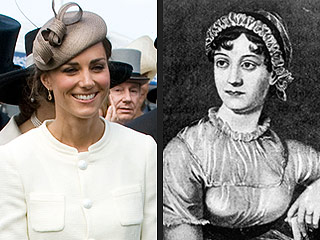
My awesome friend and fellow British drama affectionado Dahlia sent me this link today, about the discovery that Kate Middleton is distantly related to Jane Austen.


 The People magazine online article reads:

"The famed romance author (1775-1817) and the newly-minted royal, 29, have family ties, according to findings from Ancestry.com. The ladies are eleventh cousins, six times removed, according to the site, and they are linked through Henry Percy, the second Earl of Northumberland, who was born in 1392.

http://img2.timeinc.net/people/i/2011/news/110711/jane-austen-2-320.jpg"'Finding this connection between the Duchess of Cambridge and Jane Austen is very exciting since, in many ways, Catherine is the modern Jane Austen heroine: a middle-class girl marrying the future King of England,'" says lead historian Anastasia Harman.
"'Jane Austen may have written about happily-ever-after, but it seems Catherine has found a nonfiction hero to spend her life with – far past the epilogue.'" http://www.people.com/ 


To underscore the royal buzz, later, while sitting in the barber shop waiting for my son to get his haircut I perused a magazine feature about the royal wedding. It stated that about 2 billion people - 1/3 of the world's population - watched the wedding.  I don't know if that figure counts people like me who shortly after the wedding, checked out some press highlights of it... But still, two billion people?! Apparently I need to stop justifying why the heck I find the Brits so interesting. Clearly an insane number of people on this planet do.

The interesting thing about the article in the barbershop was that it was in a Christian magazine and it was explaining why the Royal wedding mattered so much with a Biblical analysis. The Biblical analysis quickly became far too esoteric for me, but the thing I took away from this is that the British people and their institutions command tremendous interest and respect worldwide.

Whether we justify if with Jane Austen and happy ever afters or with the Bible itself, people do care about what Kate is up to.

The World Does Care, Really Care, About Kate Middleton. I'm Not Sure it Matters Why. LostinBritishTV