Friday, February 17, 2012

The Misfortune of Great Beauty and Talent

Whitney Houston had a couple of tremendous disadvantages to deal with in her too-short life. The first: her astonishing gift of a voice and the second, her stunning beauty.

No one can be expected to bear that double burden and come out unscathed. That is, if one has allowed oneself to enter the world of big Celebrity.

The combination of her human failings and the American celebrity machine may be responsible for her untimely demise. Our culture collectively craved her and sought her until the craving and seeking took her over - body and soul. Only the very strongest of people can handle the burden of unbridled fame that celebrities who reach the stature of Houston have to live with and she, well, she was clearly not made of that "sterner stuff" that might have allowed her to endure.

You might (or might not) now be thinking about Charles Dickens. Yeah, probably not.

But, oddly enough, I recently learned that Dickens is someone who bore some measure of the American hunger for celebrity. This, according to a fascinating account of his first visit to America in 1842, recounted in the online BBC news magazine.
"But little by little, the enthusiasm of his American fans began to overwhelm him. When Dickens's boat made a stopover in Cleveland, he awoke to find a "party of gentlemen" staring through the cabin window as his wife lay in bed. 'If I turn into the street, I am followed by a multitude,' Dickens complained in a letter. 'I can't drink a glass of water, without having 100 people looking down my throat when I open my mouth to swallow.'
The article goes on to relay Dickens' complaints about those who tried to wring money out of his fame, such as the barber attempting to sell locks of his hair. How fascinatingly timely to examine the impact of this craving for people that our culture subsists upon. America the consumer: fast food for our bodies and fast consumption of stars for entertainment.

On a personal level, I feel terrible about what happened to Whitney Houston. I remember her from the 80s. I was young then too and envied and adored her -- like everyone else did -- for her apparent poise, grace, stature, and abundant talent. No other singer of the time could do for me what she could do. Hell with Celine Dion or Mariah Carey. They were nothing to Whitney. Her beautiful clear skinned forehead; her enormous mouth that opened to show massive rows of teeth while belting out incredible notes with that most elegant turn of her neck. She was like art in motion.

No one who could have compared the two of us then would have found my life the preferable one: nondescript, short, and unknown, I was an individual while she was an icon. And trust me, no one was sitting around craving me and my soul. But, in truth, there is no doubt that both then and now I walked the better path. From mine, the path of simple stability, I watched her take over the world and then I watched as she little by little lost everything. Actually, that is not entirely true. I stopped watching -- stopped paying attention around the time she married Bobby Brown and appeared in public looking and acting disjointed and out of touch -- using substances and craving public acceptance.

And there, right there, is the cost of fame, isn't it? Like living perpetually on that pivot point of a bad relationship -- just past the moment of heady glory where you are craved and desired, and instead in the stage of becoming a nuisance or an obligation needing to prove yourself and seek acceptance or what you loosely think is "love." Where everything you do is either ignored or misunderstood by the one(s) you think are important. The tables turned and instead of the public needing Whitney, she became the obligation, the career that was always one step behind where she wanted to be.

What can we, as a society, collectively do to prevent this cycle from continuing to churn up and spit out other young beautiful and talented souls? We must resist the craving for their bodies and their lives. I wish with all my heart that the media and individuals together could begin a transition away form the shallow consumer culture of entertainment. Yes, the media must stop feeding on it. But first the public has to stop caring! We must quit watching E Television. Quit buying People Magazine. Quit wondering who they are sleeping with or what they are wearing, eating or endorsing. Enjoy the talent but leave the people alone.

Many years ago, I transitioned from typical American girl to someone who couldn't care less about pop culture. And I am the better for it. Society is one step better for it too. I now thrive on a diet of excellent quality entertainment brought to me by performers of all sorts whose personal lives are entirely unimportant to me. This may seem shocking, but I now consider my favorite entertainers' private lives to be entirely their own business. And yes, that really DOES extend even to Richard Armitage.

I don't want to know them, be their friend, enter their private space or take their souls. I don't want to feed their addictions any more than I want them to feed mine. I simply pray for them that they never get famous enough to learn what Whitney Houston's life must have been like.

Let it begin today and let it begin with me.

Sunday, February 12, 2012

Emma Chambers looks like Claudie Blakely

You'd think that after almost two months of time off from the blog, I'd have been able to come up with something better than this. But here it is, another brief and slightly lame post:

Emma Chambers, playing Hugh Grant's sister "Honey," turns in a charming performance in Notting Hill.

While watching her in that film last night, I was convinced I'd seen her in something else before -- but I can't figure out what it could have been.  Still can't. She seems to have found fame in the Vicor of Dibley, but I've never watched that.

I think what was really going on was that she was reminding me powerfully of Claudie Blakely. I convinced myself I was watching Blakely in Notting Hill and they just didn't credit her for the role. Kidding. But seriously, these two look alike! Their eyes, noses, teeth, even a dimple.  Dead-ringers -- though about 10 years apart in age.

Oh, and as a side note, if you haven't seen it lately, you haven't seen it at all -- give Notting Hill a pop into the dvd player. You won't regret it. Funny, charming and romantic, a wonderful way to spend an evening.

Wednesday, December 21, 2011

In Defense of Scarlett O'Hara

A bit ago I threatened a post about Gone With the Wind. I might as well make good on it. I won't insult your intelligence by claiming this is British in any way (though, if I were to try, I might build on Vivien Leigh's heritage). . . . We both know this post is here only because I'm suffering from a serious case of "the holidays" and don't have many new insights to give on appropriate things.

But I find that I have a lot to say about Scarlett.

I watched this classic the other night because I'd had a fight with my sister. Aw, not a bad one – but a disagreement, a clash of the minds . . .  about Scarlett O’Hara. My lovely sis, who is brilliant and to whose opinion I generally defer under most circumstances, had seen GWTW on TV and it was on her mind. She wanted to vent about what a horrible bitch Scarlett was. Trouble is, I have always found Scarlett to be infinitely sympathetic and, if not always likeable, a basically appealing character.

But fresh in my sister's thoughts were scenes of Scarlett harshly working her convicts in the lumber mill, concerned about nothing but making money, scenes hammering home Scarlett's ambition and lack of caring, her ruthless cruelty.  I remembered those . . . but I remembered more that Scarlett was a woman of courage and passion, of strong driving energy, and of great charm -- the quintessential worthy survivor. But maybe I was wrong! Maybe my impressions were unduly influenced by the prejudices of my youth. I mean, I first read the book and saw the film when I was in high school, as an impressionable girl with limited experiences. So I watched again. Just to check.

And what I found was this: my old impressions are right. I still feel the same way about Scarlett. I don't hate her. I understand and appreciate her and what she's had to grow through. From a pampered, headstrong, vivacious girl – lacking in depth but having never really required depth to progress happily through her life, to someone who could survive at any cost by overcoming tragedies and horrors piled high upon each other.

Scarlett, as the show starts, is nothing if not supremely well-adapted to the life that she’s grown up in. A practical girl, she isn't looking for complexity or difficulties. She's looking to be happy. Of course we can fault her for being shallow and misguided (but these faults are present in many characters, even lovable ones. Emma, anyone?)  And we can also fault her for having blindly accepted the benefits of slavery without introspection. However, she cannot be singled out to carry this blame; other more sympathetic characters (Melanie?) are similarly flawed. And we might not prize her headstrong comfort-seeking, but we can accept that a great many 16-year-olds are like that, making her not all that different from some of us at 16 or even at 26.

Scarlett sees great value and takes pride in her ability to attract others, to persuade them and compel them. She has tremendous personal power and is just learning how to best wield it. Born in a more recent era, she might have been a politician or PR genius. But in her time, she uses her assets for the advantage of gaining a man. And it works extremely well for her. Scarlett is pursued by scores of young men. She, however, is only drawn to one: the most interesting of them all – a wealthy, sensitive, intellectual. Can we at least agree that her attraction to a man of depth and understanding shows good taste and judgment?

But Ashley is also Scarlett's downfall. We might applaud her taste in desiring such a man, but her steadfast adherence to the fantasy of Ashley is her biggest character flaw. She cannot move past that blind until very late in the story. She is convinced that they belong together despite powerful and continuing evidence to the contrary. It is a sad flaw but an understandable and common one.

In part because she sees herself as the tragic victim, and in part because she is confined by her time in history to think of her life’s work in terms of marriage, when Scarlett learns that Ashley is to wed another – a woman she can’t like or respect, a quiet, meek, gentle, introspective thing – she flings herself headlong into anything else and marries a ridiculous man. You know she's thinking: "it can’t possibly matter what I do now!"  This cutting off her nose to spite her face in a fit of headstrong stubbornness is, again, a flaw I find sad, but understandable -- seeing it often in my children's stubborn choices. Yes, Scarlett is childish, but I appreciate her pain and like her more for it.

The marriage to Charles and his quick death as the war sets in, mark a turning point. She has lost her youth. She will soon lose her home and her mother. It is the loss of these things in quick succession without understanding and without closure that results in her keeping Ashley so high in her thoughts as an ideal. She sees in him everything that is dignified and fine, everything that is safe and comfortable, and everything that reminds her of her past glory. The genteel life with Ashley on a dignified plantation that lives in her head sits in stark contrast to the one she’s somehow found herself in the middle of in Atlanta as war rages around her. She finds herself unwillingly nursing sick and mutilated men -- going entirely against her own nature to do it, staying in a place of danger in order to help Melanie with her baby’s birth, though doing so prevents her from being with her own people and her own home when that is all she wants.

One of the most powerful scenes in the movie, demonstrating how Scarlett has found and acts from a source of deep inner strength, is when she learns that the doctor is not coming and that Prissy “knows nothing about birthing babies.” Squaring her shoulders, she ascends the steps to tend to Melanie, to help this weak woman she thinks she hates, deliver the baby of the man she loves. Scarlett shows that she can and will step up and do what she has to. No matter what. From this point on, that will be her guiding principal: doing whatever has to be done in order to get through. The baby is born and by sheer force of will, she plows through the countryside with her little pack of helpless beings in tow and makes her way home.

Getting there just one day too late to see her beloved mother alive, but fully able to appreciate that her father is no longer of sound mind, the young disillusioned belle wants to throw herself on a bed and weep. But she can’t. Instead, she takes charge of everything around her. A force of nature, she propels everyone into action, cleaning up the house and farm and making it run. She has no patience for anyone or anything that gets in the way or causes more work. A second mantra, along the lines of "if you can’t help me just get the heck out of my way” develops for Scarlett. Scenes such as her interaction with the deserter show how far she's come and what she is willing to do to preserve her tumble-down plantation and rag-tag family. And we (like Melanie) are glad she shoots him. Every day she makes choices that seem perfectly reasonable in the context of what life has now become.

But she still thinks she wants to give it all up. When the taxes on Tara are raised to $300 she wants to take her cares to her father, or even to the servant, and ultimately to Ashley. She is desperate for someone, anyone, to take a share of the load. Her scene with Ashley in the paddock expresses the misery and fatigue of living the life she doesn’t want to live along with her deep desire for what she thinks she is in love with. She wants escape. But she doesn’t get it. Not only will he not run away with her, but Ashley is useless on the farm and only prolongs her unreasonable infatuation by saying he loves her and kissing her passionately.

More weight gets quickly piled on her. For just after this scene, she throws the overseer off her land and her father, inspired by her strong words, rides off on his horse, makes a foolish jump and dies. Now she has another dead parent and still no $300. She decides to parlay her very best value (her great personal charm) into an offer from someone who can pay that bill. She starts with Rhett Butler (who I'll talk about in a minute). She tries to charm him and then outright proposition him. She’s willing to humiliate herself but even he can’t help her. So when she sees Frank Kennedy and learns that he has money, she plows in headlong. Of course stealing her sister's beau is a pretty bad thing. I'll grant that. But I'll defend her motives. She is not personally interested in getting rich here (not yet); she's interested in saving her farm and her family, keeping her home together, her parents' memory intact, and to maintain what they have left.

At this crucial juncture in the story, it is interesting to note that both the man she loves and the man who loves her have utterly failed to help her and she's on her own.  And this, finally, is a theme that comes newly to me upon this recent viewing. Scarlett becomes who she is in large measure because of the way others have let her down (her mom, by dying; her dad, by losing his mind, then dying; but particularly the love interests in her life). Ashley admits as much himself after Scarlett comes home married to Frank: “its all my fault; I should have committed highway robbery rather than let you sell yourself in marriage to a man you don’t love.” Exactly! But he didn't. He talked to her about honor and love and encouraged her fantasies but made no move to put money in her hands. Rhett is worse -- when she asks for his help he toys with her and laughs at her, baits her, but won't even provide a shoulder of sympathy or a strategy to get that cash. I'll talk more about him in a minute. (I know I said that before, but I'll get to him).

Before I do, first, some thoughts on Scarlett's toughness and power. At the point where she marries Frank, she turns another corner. Her motivations start to blur. She now has enough money to save Tara, but now that is no longer enough. She learns that she is shrewd at business and she wants to amass wealth -- enough so that no one can ever threaten her again. This is the point when she starts to lose her soul. She is so attached to an idea of poverty that she can’t see. She says: “I found out that money is the most important thing in the world”. I don’t like who she becomes, but I understand how she got there -- what motivates her.  She sees paths with beacon lights shining down that lead to more and better ways of making money. It is easy for her and sooooo seductive. But she doesn't have a mommy who can help her see bigger, more important values. Though shrewd and smart in business, she is thick and slow in life. She doesn’t see larger implications of her own actions. The night of the Shantytown raid is the perfect example. She is like a child seeing only the surface and misunderstanding everything. It’s a scary mix of qualities – headstrong capitalist, deeply infatuated with a man who is symbolic of everything she’s lost, in deep grief for the loss of her way of life and her parents but far too superficial to even realize she’s in grief, on top of everything insanely charming and persuasive. No one can possibly stand up to her - except for one man. But he fails her entirely.

So now we finally get to Rhett: the one person who is strong enough to balance her. The one who could have made a difference had he been really willing to take her on. But he fails her! I thought that upon a new viewing of the movie I might, as a grown-up, form new harsher impressions of Scarlett than those I'd formed as a child in love with her charm and vivacity. But something surprising happened. Instead, I found a new disappointment in Rhett.
Rhett lets her down so very many times, usually justifying it by convincing himself she can handle things herself. But how can a young woman with no resources and nothing but spunk and charm and an enormous amount of naivety possibly be able to negotiate the demands of the post Civil War south without making great errors? Rhett begins this illustrious trail of failure when he dumps her on the road to Tara, leaving her to manage three helpless beings in a wagon with absolutely no notion of what they'd find at home. This really is inexcusable. Any person with his resources and experience should have finished seeing her home before heading off to war. When she goes to him in jail and connives for money, he not only doesn't give it to her, but much worse still, makes fun of her, toys with her, doesn't take her plight seriously, and then later, ridicules her for having married Frank.

He may be in love with her, but he’s absolutely useless to her. After Frank dies and she’s pouring out her heart to him in the most honest and real display of vulnerability she has ever shown, he again, diminishes her. I never noticed this before -- being too caught up in the intense sexiness of the proposal scene. But he doesn’t even try to hear her, to understand her feelings, or engage with her in a meaningful way. He just finds her amusing. He chooses to make sport of her and keep her at arms reach. He can’t really love. But he asks her to marry him anyway.

During their marriage, things fall apart slowly. He is aware of her infatuation for Ashley and it makes him insanely jealous, but he makes very little effort to actually address it -- to think about or counter what Ashley must mean to her to inspire such feelings. He won't seek her respect or talk with her seriously. At several points in their marriage, such as when he comes back after going off on a trip with Bonnie and she greets him with a genuine smile, or when he comes into her room the morning after his passionate sweeping her up the steps and she is in a very sweet temper, he fails to pay any attention to her friendly signals. These are as big as neon signs and anyone paying a modicum of attention to his wife could read them. But he doesn't. We think of Scarlett as being cruel to Rhett -- and she is -- but he is just as cruel. And his cruelty is worse because he has so much more personal freedom and power.

The birth of Bonnie Blue is a whole other double edged sword that harms this ill-fated couple. Bonnie should be Scarlett’s savior – a chance to connect with real virtue, real meaning. But it does the opposite; it makes her thoughts turn to Ashley as she sees motherhood diminishing her value and attractiveness as a woman. In her simple, mixed-up, confounded mind she thinks of Ashley being celibate (because Melanie can’t have children) and takes up the idea to turn away from Rhett in order to live in a state of cherished ideas; if she can’t be with Ashley she can live a celibate life too thinking about him. Rhett tells her she’s “throwing away happiness with both hands” looking for something that can never make her happy. Which is exactly what she’s doing; but she is far too simple to see it. Bonnie's birth creates another great rift for this marriage. Bonnie usurps Scarlett as object of devotion and sweet love for Rhett (of the kind we saw on the cruise/honeymoon). Rhett no longer needs to make any effort to be kind and gentle to Scarlett, because Bonnie can be his object of devotion. Oddly, this child has torn apart anything that bound these two together.

And we all know the famous ending -- how Melanie finally dies and Scarlett realizes how much she loved and cared for her all along. And, more importantly, how Scarlett realizes that, even though now she might conceivably have him, Ashley is not at all what she wants. She runs to find Rhett who has suddenly and inexplicably given up all interest in her and tells her he doesn't give a damn. Cue the personal revelations of Scarlett as she mourns his loss for a moment or two before realizing she should go home to the red earth from whence she gets her strength.

Ultimately, the question of whether Scarlett does gets him back -- at some point to be determined later -- doesn't really matter. (Though I think she does. Get him back, I mean.  If Scarlett O'Hara puts her determination toward solving some problem, it is pretty likely that that problem will be solved). But there is no doubt that Scarlett will be fine. She is already fine. She will go back to Tara and, with or without Rhett, lead a happy, full and probably seriously messed up life!


One final thought: I am so thankful for the astonishing Vivien Leigh who is both so stunningly beautiful and so profoundly talented in this role that she takes over my entire brain. This performance was a gift to the world for all time.

Wednesday, December 14, 2011

The Seasonally Challenged

I've come to realize that blogs may be incompatible with Christmastime. I have not posted a thing in many many days. (Of course, my last post was long enough to count for about 4, so maybe I'm really not that far behind.)

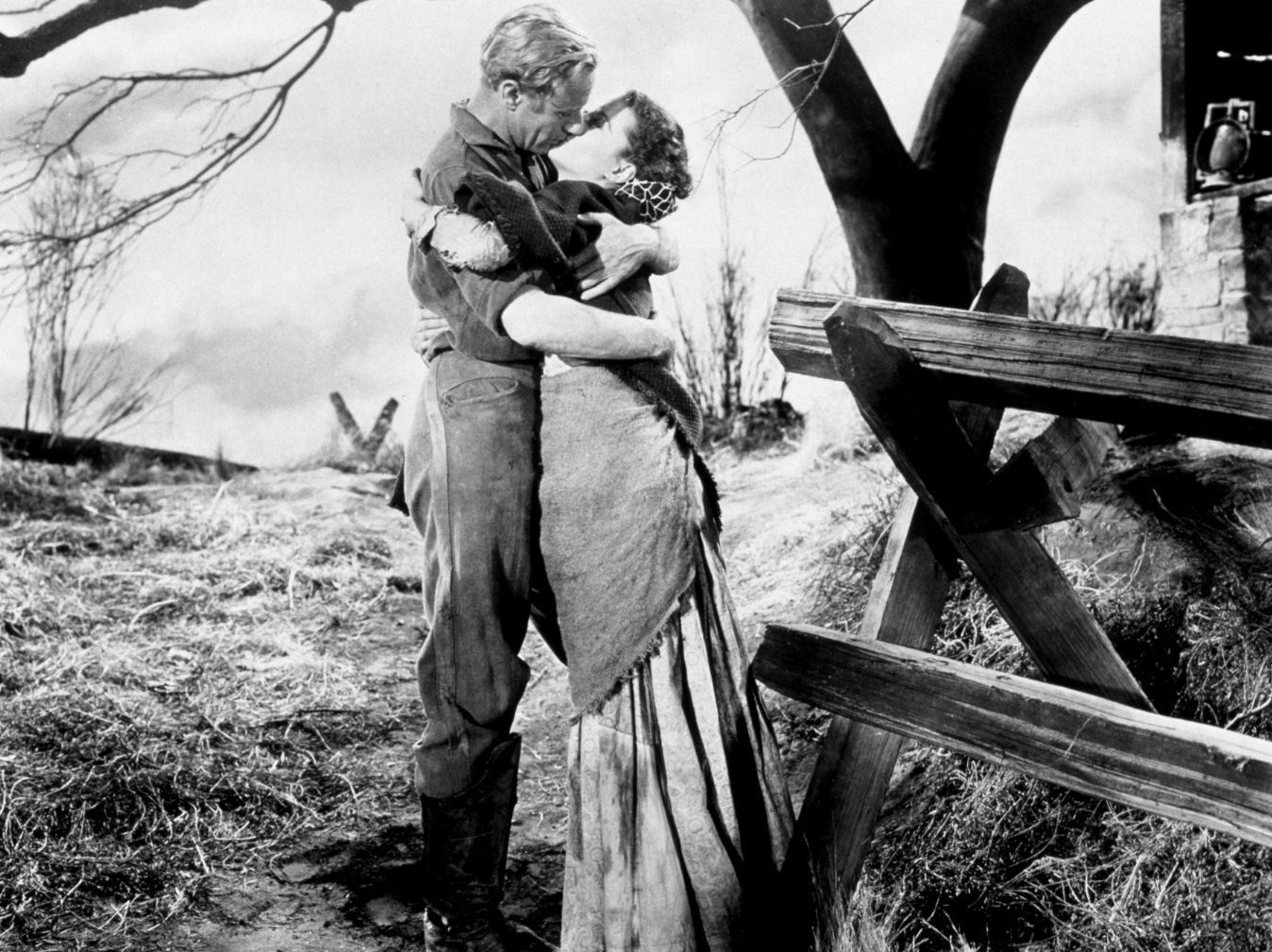
Anyway, several problems are plaguing me - not the least of which is that nothing I'm doing has anything to do with British television. I did watch Gone with the Wind the other day and was thinking that Vivian Leigh and Leslie Howard were British. . . and not only that, but Olivia de Haviland played Maid Marian in Robin Hood and that is a British thing . . . hmm

So, I guess it comes down to this: you can either expect a post on Gone With the Wind accompanied by some lame and strained rationalizations as to why it belongs on my blog, or it may be awhile before I check in again. We'll have to see how it goes : )

In the meantime, enjoy your holiday time!

Thursday, December 1, 2011

Spooks Ending: A Real. Life. Fail.

After the miserable ending to that brilliant show, I just stopped thinking about it. Yes, OK, it was a process... It took a blog post and a few days of decompressing to stop thinking about Spooks. But I did stop. I didn't reflect on it, try to put it all in context, or ruminate about the larger meaning of fiction and it's role in our lives. I just stuffed the experience in a file drawer and walked away.  I walked across the Atlantic and immersed myself in other pursuits (knitting, Star Trek Voyager, and holidays).

That worked for me.

However, over the course of the last week or two, I've had too many occasions that brought up the show and I'm realizing that I do need to do a bit of dredging up and processing before I can fairly and legitimately stuff it all back in the file again and walk away for good. If you, too, are on a Spooks' healing process, read on. Maybe I can be of assistance.

SPOILER ALERT through 10.6. There are references here to events that happened throughout the whole run of this show. Please beware.

With its ending, Spooks, as a series, failed. The "ending" I'm speaking of, is the one that began in Season 9 and continued up until the last pathetic moments -- as life leaked out of the franchise in a sad and plaintive way.

Somewhere during its run, Spooks seized hold of the mantra: "we don't do happy" and decided to run with it to an extreme degree. By adhering to a very limited world view and by intentionally killing or destroying everything that made the show special and real, Spooks ultimately killed itself.

There are two themes to its failure: (1) the first is the increasingly ruthless way that major characters were slaughtered until those losses displaced all deeper meaning, and (2) how the show lost its brilliant focus on team, continuity, cohesion and worthiness as the losses mounted without commensurate meaningful acts. One connection in particular which was the lifeblood of the show (Harry and Ruth) was thrown away cheaply.


I. An increasingly deep trail of bloodshed.

The first few years of the show contained significantly less killing of major characters than later ones did. Don't believe it? Look at this chart. Through the end of the first 3 seasons, only Danny and Helen were killed off. Three seasons, two deaths. And both were treated as catastrophic events for the team. Helen's death was met with assassination and a serious sense of vengeance; and Danny's was met with a distraught Ruth grieving and the whole team's mourning at a funeral. During those same 3 years, four agents (Tessa, Tom, Zoe and Sam) were allowed to leave the show alive and intact.

Then things started to change. The deaths began to rack up. Slowly at first, then fast and furious.
Consider this:
• In Season 4 only Fiona died.
• In Season 5, Collin.
• In Season 6, just Zaf. That's it.

Then the bloodbath began in earnest -- in fast succession we lost Adam, Ben, Connie, Jo, Ros and Lucas. Three seasons, six agents. (Make that 8 agents in 4 Seasons if you add in the last). With hardly more than a "safe" episode tucked in between to grieve, the bodies fell and Spooks began to lose its soul. Somewhere along the way, it gravitated toward a basic premise of "no one here gets out alive" -- and we are all diminished by it. Though lip-service was paid to the agents' sorrow over these deaths, overall there was no time to worry about what all this killing was doing to anyone. The show just plunged in, taking no prisoners.

However, even with these mounting losses, for a long time the show still sustained its history, continuity and cohesiveness because the teams were allowed to regenerate and rebuild (if not to grieve).  Up till and including the end of Season 8, I didn't really mind losing our best and brightest. Because there were always new and bright replacements to bond with. (For instance, after Danny left, we got Zaf; when Fiona died we got Jo; when Adam went, Lucas came.) The show continually renewed itself with fresh (and sometimes even better) characters than the ones who were leaving. New relationships were forged, new teams bonded. And it all still felt meaningful and real.

As long as the show was a process, the continual regeneration and recycling wasn't the death knell. And the show was BRILLIANT about getting actors and characters that clicked. ...And also at introducing them at just the right time and under just the right circumstances to increase bonding.

All that changed by Season 9.


II. When they stopped building teams.

Put yourself back in Season 8 for a moment. Think about the mix of characters and the tremendous chemistry and potential there. We start the year with Harry, Malcolm, Ruth, Jo, Ros, Lucas and Tariq. What an incredible team. Ruth was new to this particular mix, but she shared strong history with Harry, Malcolm and Jo. By the time we lost Malcolm, Jo and Ros, we were already bonding with Tariq, and Ruth was fully phased in. It felt smooth and seamless and it worked.

Meanwhile, Ruth's interactions with Harry were powerful, sad and sexy. We were fully invested in what would happen to them and all the agents around them. It was great TV. And that greatness withstood and transcended the loss of some of the best characters the show has ever known.

But, then with Season 9 and continuing into 10, the show seemed suddenly bent on destroying itself from the inside out. The meaning seemed to take a back seat and character development and trust stopped mattering. Things that a viewer had a right to rely upon were jerked away.

Here are a few ways in which that happened:

• Slowly the character of Lucas became meaningless over the course of Season 9 with unreasonable behavior and ridiculous motivations that changed who he was as a person and what we had come to believe. All this was done toward no real end other than to woo viewers.
• Ruth and Harry's love became untenable. Despite a season of buildup and a proposal she should have respected if not craved, Ruth's character not only denied herself happiness but denied herself even the comfort of some rational motivation for staying celibate.
• The story of Harry and Ruth longing for something greater, was built up and built up but then relegated to a back burner -- artificially prolonged past the point of reasonable anticipation. And toward what end? Apparently only for the hope of stringing along viewers.
• A character like Beth was allowed to be flawed and multi-faceted and then allowed to grow, undergo change, become meaningful and trustworthy, only to be abruptly dismissed (off-camera) with no closure at the start of Season 10. What was the point of that? I suppose they couldn't do anything about Sophia Myles not wanting to stay on for another season, but they could have gotten her to do a single episode and then maybe kill her -- that would at least have preserved her memory, given the remains of the team a bonding moment, and allowed her character some enduring meaning.
• The teamwork between Lucas, Beth and Dimitri, which was one of the highlights of Season 9, was entirely squandered after Lucas died, leaving Dimitri alone and adrift in a room full of strangers at the start of Season 10.
• With a much diminished continuing cast including only Harry, Ruth, Tariq and Dimitri who had appeared before on the show, Spooks limped into Season 10. Instead of immediately drawing upon past themes and building continuity they so desperately needed, the writers went and took out Tariq! One of the few who was actually part of a continuing team.
• They should have allowed their few continuing characters to bond and close ranks, then bring on the newbies in a more subtle way. Hitting us over the head with Calum and Erin Watts was jarring and awkward.
• The flow that was stilted because of character loss could still have been compensated for with continuing plot lines. But we didn't get that either. Almost no mention was made of the massive Lucas North/Albany File build-up. And Ruth and Harry lost all the momentum they had gained by Harry's act of passion at the end of Season 9. Lost without reason. It would have healed so many flaws to have allowed a proper conversation about what Harry did and what it meant.
• Instead, a Russian past was constructed for Harry that did nothing to draw in the other characters or provide the type of background that could ultimately build sympathy and connection for our team.
• As if the bonds weren't decimated enough, Ruth was then pulled into the Home Secretary's office, taking her away from section D too.
• I remember that I was excited to hear rumors that someone, probably Tom, would come back for a cameo in Season 10. Great idea. But even this was so horribly executed it provided nothing. Was Ruth allowed to see and connect with Tom? No. He showed up in the final minutes of the final episode in order to walk alone down a hallway. Someone who could have actually provided a meaningful link to the past was wasted.

The writers couldn't have dismantled the continuity of this show any more had they tried.


III. How the show squandered its amazing Harry/Ruth story

And the main way (the saddest way) that they dismantled the great things they had was they way they messed with Harry and Ruth. Maybe you've noticed, I haven't yet even mentioned how they killed off Ruth in the last episode. And I was more than a little upset by that. But more than the death of Ruth, I am disturbed by the way the writers squandered who she was and how she had moved forward. Her character became pointless. It underscores the lack of grounding to have taken her life just to prove that they could.

I did not need Harry and Ruth to have lived happily ever after, married and settled in a nice cottage somewhere. But there was no conceivable reason to have denied them some resolution, some real love scenes. They were artifically held in limbo and then denied real consummation. Their chemistry and motivations were squandered. And this incredibly powerful story lost.

Anyone may know how much I cared about Harry and Ruth as a couple. And I was hardly alone in that regard. "Harry and Ruth" had a life of their own that was bigger than Spooks as a show.

I now realize that this amazing couple was not a product of the show and its writers. It came from Nicola Walker and Peter Firth. It is common knowledge that the writers didn't plan that romance, but I now realize that they really didn't know what to do with it once it showed up in front of them. It proceeded organically from two talented actors, thus, their very best moments came when the writers weren't trying to manage it, but when Nicola and Peter managed to infuse regular interactions with more meaning and eye contact. In Season 10, the romance felt thin and squashed by the plot lines they were required to follow.  (Now I'm just hoping that some other directors/producers are smart enough to see Peter and Nicola and their great talent and chemistry together and give them work together on some project that really can "handle" them better. Its a dream.)

I could be imagining it, but when I was watching the last episode --and it became clear they were offing Ruth -- I could almost see Peter Firth's acting breaking down. It seemed to me that he (as an actor) just couldn't hang with it anymore because it was becoming so stupid. It really seemed to me as if he was distancing himself and closing down. He seemed to be sleepwalking through those last moments unable to find a place of truth and reality to draw upon. What a shame to have done this to Harry. To make the last 10 years condense down to the plugging away at a desk, endlessly fighting lost battles.


In Conclusion
 
In its early years, throughout all its traumas, Spooks always carried with it a mantle of care and tightness between our team members. Some reasonable mix of happy/love/pain/death/ambiguity would have been a vision of "giving of oneself, in the public service" that I could hang with. Now it seems that the writers wanted it to end on a note of: "we don't do happy and everyone must die or toil endlessly toward the same miserable end." Hmmm. That's what I waited 10 seasons for?

Yes, its just a show. It's only TV. But, really great fiction is more than just fiction. It mirrors reality. Books, movies, music and TV, are the stuff of life. They intentionally work on us at an emotional level. They are supposed to do that. Really good fiction does owe us something. I don't watch bad fiction. I don't read bad fiction and I don't listen to bad music because I won't allow myself to be manipulated and jerked around by "powerful" media that is "weak" in quality. Powerful media that is good is one of the best things in life.

This show was rare in that it did feel important and had so much capacity to be brilliant. Fiction does have the power to move people and create a reality. Spooks as its best did that and I think that's why people feel so let down when it fails. It diminishes us as viewers and makes the whole thing feel false.

Tuesday, November 29, 2011

Jobs, Taylor and Spooks

I had a strong desire to listen to Carolina in My Mind by James Taylor this morning. It must be the time of year. November makes me nostalgically wistful and fills me with a sense of longing. Because I don't actually own the song, I went to Youtube to have a listen and whilst there made another discovery. James Taylor reminds me of Steve Jobs.

Sure there's the superficial similarity of a glossy round head, but its more than that. I see deeper resemblance in the chin, eyebrows, nose and sharp, brilliant eyes. Both were visionaries with soft voices and deeply moving intelligence and they may share a lot more than just physical similarities . . .  if I were to stop and think about it I could let you know.  But this post wasn't really supposed to be about them.

Instead, and in addition to the Jobs/Taylor connection, I was thinking about my connections related to that song. Carolina in My Mind is meaningful--a sad and longing song with a positive message about finding what you need inside of you. Taylor said he wrote it while feeling homesick though he didn't really have a home at the time. That's an unsettling sentiment that I totally understand.

I don't know when I first became aware of this song, but sometime, while I was still very young (far too young to really know what it felt to be lonely, removed, and homesick) I first loved it. The ideas in the song touched me. And then later, as an adult, the larger force of the deep longing settled upon me while spending Christmas alone in California far from home. And still later, a few years ago, a good dear friend (who I now miss) drew the song and its message to my attention yet again.

While listening to it today, tears streamed down my cheeks thinking about that friend and I wondered: why did I feel drawn to listen to something I knew would make me sad?

And that, friends, is how I finally get around to the British tv connection and how this post has anything to do with this blog.

This week I've been getting a number of comments and e-mails from those who have felt disappointed and saddened by the Spooks ending (like so many of us were). Someone wrote to me today about being a glutton for punishment by continuing to listen to music from that series though it brought up the sad ending all over again. We all do things like this. But why?

I have to think that making ourselves sad, reveling in our grief, must somehow be a healing act. By taking the time to really feel a loss, we can start to mend at a cellular level. Dredge up the muck, before just paving over the surface. Maybe for me, the call to hear sad songs at Christmastime and have a good cry over friends and family who are gone and places we aren't able to be is a way to prepare for joy. And maybe for those who confront, head-on, their grief over how Spooks ended, will ultimately enjoy that same healing and state of calm.

Me, on the other hand. Well, I'm still not ready to do that with Spooks. I'd rather pretend that the whole last series/season didn't exist. Denial, you see ;)  Just an earlier stage of grief.

Sunday, November 27, 2011

The Muppets, The Movie . . . And Me

British TV may be fabulous, but it's not the only thing worth doing. Right in line with that theme, I just came from the new Muppets movie and I'll tell you this: it was great. There were as many "unaccompanied" grown ups in the audience as there were kids and most of them were laughing hard.

The movie was unusual for its continual breaking of that "4th wall" with characters referring to the earlier song numbers or making little jokes about the plot and length of the movie. The whole thing was charming, funny and self aware with lots of great cracks directed at the washed up Muppets of the olden days.

Somehow all the silliness managed to inspire real moments of wistfulness and remembrance and I was surprised to find a lump in my throat and tears in my eyes when Miss Piggy and Kermit finally reunited on stage for a rendition of The Rainbow Connection. There were lots of new songs too and many were quite excellent -- especially Man or Muppet which now plays continually in my mind (owing to the fact that we immediately bought the soundtrack) and in which Jason Segel gets to sing lines like "Am I a man or am I a Muppet?! If I'm a Muppet. .  . then I'm a very manly Muppet." He is brilliant in this role, managing to really make us believe in the strange set up.

Amy Adams too, is simply made for movies like this. She's become a Carole Burnett-like figure -- in that blatantly talented, beautiful, singing, dancing, poised and funny sort of way.

And whatever musical genius arranged Smells Like Teen Spirit for Muppet barbershop quartet needs, seriously, to win some awards. Stunningly funny.

A great many stars have cameos in the movie, including Neil Patrick Harris -- which caused me to have a major breakthrough -- I realized I get him confused with Justin Timberlake. This has happened to me before, but I never put my finger on the phenomenon until now.  I don't know if anyone else has this same Harris/Timberlake problem  -- so I am posting the following just to prove I am not crazy. (Although, maybe the following just proves that I am.)

Thursday, November 24, 2011

Thanksgiving - Possibly the Only American Cultural Holiday Tradition

Thanksgiving has never been my favorite holiday, for a variety of reasons I won't get into since this post is actually about why Thanksgiving is a great holiday!  This year I had a revelation that gave me a new appreciation and fondness for this day.

I realized that Thanksgiving is truly the only uniquely American cultural-event routinely celebrated by masses of Americans every year. All other major holidays in this country are religious-based (like Christmas and Easter) or political/military/social policy-based (like Veteran's Day or Washington's Birthday). The latter category is interesting and includes most of our holidays -- those designated in order to support some political or social agenda item. Not that it is always a bad idea to support social agendas with holidays, just that doing so makes them a bit different than say, a group of people choosing on its own, to be thankful.

Just to prove it, I did some research. Here is a list of all federal holidays according to USA.gov:
  • MLK Day - political/military/policy
  • Groundhog Day - close runner up
  • Valentine’s Day – celebrated all around the world
  • Washington’s Birthday – political/military/policy
  • Easter - Religious
  • Earth Day – political/military/policy
  • National Arbor Day – political/military/policy
  • Mother’s Day – enacted in 1914 to support a particular group : )
  • Memorial Day – political/military/policy
  • Flag Day – political/military/policy
  • Father’s Day – enacted in 1909 to support a particular group : )
  • Independence Day – political/military/policy
  • Labor Day – political/military/policy
  • Columbus Day – political/military/policy
  • Halloween – an odd duck
  • Veteran’s Day – political/military/policy
  • Thanksgiving
  • Pearl Harbor Remembrance Day – political/military/policy
  • Christmas - Religious
Most of these, even Mother’s and Father’s Days, were put into place in order to support some group or idea that the government felt needed supporting. Only a couple of other holidays are spontaneous celebrations of some cultural phenomenon. Thus, only Groundhog’s Day, Valentine’s Day and Halloween come close to what being what Thanksgiving is. But Groundhog’s is hardly a culturally iconic day. It’s cute. And it has a great movie. But no one celebrates it. And Valentine’s Day is actually celebrated all over the world, making it not-uniquely-American. Then there's Halloween . . . well, that's an odd one. There are roots to Halloween that border on religious, but the holiday in its current iteration is really a recent phenomenon, not a deeply embedded tradition. I don’t know what to do about it, so I’ll just disregard it : )

Next consider the religious holidays. It’s not that they too can’t have an overarching cultural significance that binds people and place together. But we have challenges in America with finding deeper cultural connectivity through religion due to our multi-cultural and -religious history. These holidays aren't what I'm talking about.  They do include cultural traditions, but are loaded with Christian significance and meaning that most people would say is (or at least pay lip service to the idea that it is) the more important focus.

So, its just Thanksgiving that has the true power to bind us in a holistic way as a nation. FN

Fn. . . Lets just get some housekeeping things out of the way. . .  First, yes I know there are many other countries and cultures that also have harvest festivals. I even know that “Thanksgiving” is celebrated in Canada and in a smattering of other countries around the world. But I am talking about “our” Thanksgiving – our pilgrims and Indians meeting in friendship and brotherhood (on that one day anyway). I also don’t want to get into how horrible the colonization of this land was. The fact of being thankful for the bounty of the land is not a by-product of evil colonization. It is just lovely and good idea. I also know that the government, at some point, put its imprimatur on Thanksgiving (just as it did with all the others) but that doesn’t convert a cultural tradition into a socio-political act. Lets not get caught up in these technical details.

I have often felt that there really is no such thing as an “American” culture and that Americans are diminished by that lack. Thanksgiving comes the closest to providing a cultural moment – with a tradition that has been celebrated in this land as long as (and longer than) there has been a “United States of America”. That is a wonderful thing to have when we have so little else culturally binding us.

Anyone in this county – anyone – can celebrate Thanksgiving with everyone else. (You don't have to be Anglo, Christian, or rich to give thanks. You don't have to like football and even vegetarians can participate.) Wow.

The beauty of the thought -- the real need that Thanksgiving fills, is in taking the time to be thankful: feeling deeply and truly our good fortune. Feeling it personally and feeling it as a nation. For no matter how bad things may seem we are most certainly among the wealthiest, most comfortable set of people to ever walk the earth.  Be aware of our great good fortune. And Happy Thanksgiving!