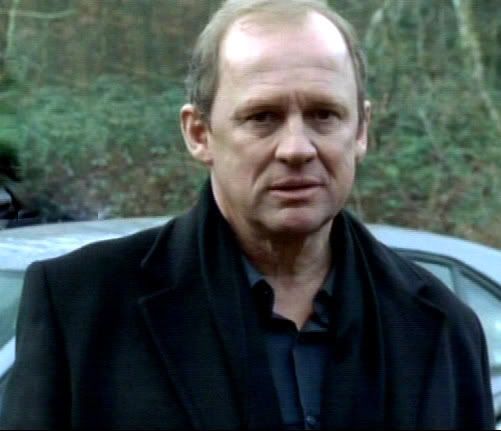
And I guess there is no sense in being coy any longer: I'm talking now about the love story of Harry Pearce and Ruth Evershed in Spooks (MI-5). The show has long since run its course and the relationship reached its final realization, so I guess it's written in stone, right? and must be accepted as final?
Nah.... Why let a great but flawed story languish? It deserves to be picked up and re-knit into a more appropriate shape. Or, to continue the prior metaphor: someone must chisel the stone so it is re-framed for eternity in a better way... That is my not, as it turns out, insignificant goal.
Maybe this would be a good place to mention that this article is FULL OF SPOILERS!
Please stop reading and walk quickly away if you don't want to know how Spooks treated its most important couple, not to mention myriad other details related to the entire run of the show that I will let fly without fanfare as necessary (oh, and I also spoil Josh and Donna in The West Wing and Stevens and Miss Kenton in Remains of the Day somewhere in here, so you might be on the lookout for that as well).
OK. It is no secret to anyone who's read my blog that I am mortified by how the relationship between Harry and Ruth, two passionately attracted people, concluded. But my frustration goes beyond that. I am troubled by the lost potential in the last 2 seasons, especially season 10, as the characters were forced to behave in a way that defied sense and desire while the show slowly dissipated their charisma and made them, particularly Ruth, somewhat pointless.
Now, I am certainly no screen writer nor dramatist and I realize that it is the height of arrogance to claim that I could have done this better and yet, that is what I am claiming! I will not accomplish this through fanfic (because, honestly, I am not a fiction writer at all, even at that standard) but rather through a description of how it could have and should have gone, with a deep character analysis supporting why I think so.
If that doesn't sound like fun, you should probably walk away now ;)
Oh alright, I take it back, there's a little bit of fanfic, just a smidge. Look for (or avoid) the italicized portions, as the case may be, and please, be advised that to whatever extent it might be deemed necessary to disclaim interest, and as is probably obvious, I do not own the characters Harry and Ruth, nor any part of Spooks, which is/are the property of Kudos Entertainment and the BBC.
To anyone that is still left, this will probably be unnecessary, but just in case: Spooks follows the adventures of the team of British spies that work under Harry Pearce in Section D of MI-5. These folks include field agents that inject themselves into deeply disturbing and dangerous threats to the British people and work selflessly and tirelessly to thwart them. They live, eat, breathe, and sleep spy services. Most of them are somewhat flawed characters and all of them deserve deep respect for the kind of danger they are willing to accept in service of the free world. Harry is at the center of the force, providing a sometimes clear, sometimes cold and always nuanced vision for how to keep terrorism at bay. The staff that works for him may not always agree with him, and may at times get angry or irritated, but they always do his bidding. In addition to the field agents, a small cache of researchers, techies, and random support individuals populate the "grid," the control center where Harry has his office. Ruth is not an original character. She enters the team in its second year ("series" in England, "season" in America. I will try to stick with "season" here, so that I can refer to the show in its entirety as a "Series"). She transfers over on temporary assignment from GCHQ -- the branch of government primarily involved in tracking communications -- and quickly becomes ensconced in Section D. She fits in with the group and brings an earnest and highly intellectual 'Everyman' energy to it. She is not naive : ) but is most likely to be horrified when things are horrible; she is affected by the human costs of their missions.
When she meets Harry, she catches his attention, maybe attraction, early on. For her part, at first, she seems to find Harry a bit off-putting, certainly formidable, and is perhaps more drawn to Tom, the team's first section chief. Soon, though, we see her start to admire Harry and get sucked in to his power aura. The early seasons did not have any coordinated plan for the two to be digging on each other, but the fine actors who play these roles (Peter Firth and Nicola Walker) had great chemistry and, according to all accounts, played up their spark any chance they got. The writers seized on the attraction and developed the story. Thus in the early days, the Harry/Ruth ("HR") relationship feels a bit chaotic as odd bursts of interest are followed by distinct indifference.
 By the end of season 3, however, I think we can identify a deeper confidential working-relationship taking hold. By episode 3.9 when Harry asks for her help with an interview, we see that Ruth may have supplanted the other team members in being Harry's chief confidant. We feel that she is crushing on him a bit too and maybe that he doesn't really see it, or isn't that interested (such as when she tells him in 3.9 that he paces, "but only in a good way"... or in 4.6 when he asks her to "close the door" and she exudes willingness with the word: "Harry," but obvious disappointment when he only wants a file. There is no doubt, by the time of Danny's funeral (4.1), that there is some personal closeness as well as professional, yet, really no sense that they have any extracurricular time together. We plow along happily with closeness emerging and then fading and it is all pretty nice -- and of course drawn out, given that this is TV.
It is not until episode 4.9 that a misstep occurs and it is not until the final moments of this great "bus-scene" episode when it happens. Let's step in at that episode: Harry has been dismissed from his position due to having made an ostensibly bad choice to allow a man to walk despite the Americans wanting him extradited. We experience Harry in a light we don't often see -- a softer light. We see what his life might have looked like had he been just an ordinary middle-aged man: walking the dog, watching tv, visiting the corner store. Of course there is more going on under that surface, but the tone and his attitude in the episode are decidedly human/personal/non-supervisory.

Midway through the show, when Ruth is riding home on the bus, we are treated to a dream-like diversion. Nothing but soft red tail-lights illuminate her lovely face, and the gentle jostling of the bus gives movement to the scene while she reads a novel. Harry slides quietly in behind her, wearing casual clothes, and they enjoy a civilian moment. Ruth wants to know how he knew she'd be there, and Harry admits to having seen her waiting for a bus once in the rain after work. He drove on by that night, he tells her, and is now both ashamed and full of regret for not having stopped. The viewer gladly basks in the image of a soaking wet Ruth in his car that past night, and can enjoy imagining what, exactly, he regrets not having done. Whether he considered then, (or is considering, now) propositioning her, he could not have used the word "regret" in such a way -- soft voice, romantic setting, on a night where they find themselves un-encumbered by employee/boss constraints -- without understanding it's force. He goes a bit beyond desire and into the world of hinting. (And anyone who's ever wrestled with the question: 'does he like me?', knows the importance of such a hint .) Yes, Harry backs off quickly and brings up a co-worker. (And yes, that abrupt change splashes water on the moment. She had been letting her arm linger over the back of the bus seat while handing him a memory card and her body language was quite welcoming. His bringing up work caused her to shrink. So, closeness is explored, work interjects, closeness is shattered.
It's a good story and I don't blame the writers for not taking things further on this night. I love the bus scene and have no problem with its ebb/flow nature. But the show's ending missed the boat, er, the bus -, by shifting the tone too decidedly back to business as usual without Harry owning his actions and acknowledging the forward progress made. Just a tiny bit would have done. True, neither of the characters is "emotionally forthright", but they are not stupid. A soft and ambiguous line was, if not crossed, at least stepped on. So let's do this: when Harry enters the dark grid at the end of his exile and spots Ruth sitting alone welcoming him back with a warm smile, he swallows hard, then slowly walks up to her. He gives her a momentary gaze, perhaps just a tiny diversion toward her mouth. Of course Peter Firth is up to the challenge of conveying regret that things aren't different, overwhelming contentment at being back in his job, and hesitancy about re-approaching her in such a personal manner as he had on the bus, given his re-installment. We don't need much more than that and then he can deliver his line about getting up to speed with the files, but do it to her face with more self-consciousness. Ruth truly doesn't expect more, and Nicola Walker's performance can stay essentially the same: a minuscule cocking of her head and a tiny lean forward, then a teasing reminder of their last encounter, saying she'll take the last bus. It just gets to Harry a bit more; he can be seen processing the tet-a-tet on the bus, squaring shoulders, and choosing work.
At this part of the Series, Ruth's interest in Harry has now become palpable. She is in utter awe about this guy's job and his ability to do it. She doesn't approve of everything he does or fawn over him, but she has a profound reaction to his power and importance. (If you are the kind of woman who understands what I mean here, well, ... you understand what I mean.) Yes, she sees him as flawed and even irritating, and yes she desires him, but her main goal is to support him and she is just glad she gets to be in the umbra. She is, this night, probably highly available were he to reach out, but she doesn't expect it and probably isn't all that troubled when he doesn't. But she's not a machine. Her feelings have been engaged and then discarded and she feels it.
The next episode, 4.10, is wonderful for them and can remain unchanged. Ruth has a certain cache of power because she has brought an intense crises under control (the one where Angela, a former spook has held them all hostage). Maybe Ruth's increased power turns him on? because Harry lets loose on her after he praises her work and she responds with sarcasm. He grabs her arm and pushes her against a wall, saying "you think I'm a limited man; you think I don't understand the emotional side." He is, ironically, inches from her face while declaring that "self-control, self-denial" are the things that keep him together -- getting as passionate with Ruth as he is ever allowed to do in the Series. Yet the message is chilling. Regardless of any regrets he may have in being emotionally unavailable to her, he means to stay in control of himself.
That being the last episode of the season, when we come back, we are glad to see HR still looking close and companionable (for instance sitting neatly together on the couch after Colin's death (5.1). But the most important moment comes when Juliet probes the nature of their relationship by asking: "are you in love with Ruth, Harry?" When he doesn't answer, she tells him: "well, she's in love with you." The attraction is starting to feel obvious and natural to the other characters that populate the grid, so we shouldn't be surprised that Harry takes the next step, and asks Ruth out on a date, right? Wrong! That next step is an extraordinary break with what we had a right to expect.
I can't -- I won't -- fault anything about the dinner invitation in 5.3 -- a truly perfect moment in TV. But, if we're being scrupulously honest here, it doesn't make sense for him to go from a passionate denial of the human side in 4.10, to a friendly, matter-of-course, dinner invite just a couple episodes later, with no apparent compunction for job entanglements or the need to stay emotionally pure that was his driving force just a moment ago. For this decision to have Truth we have to consider what changed. I think that when Juliet suggests to Harry that Ruth is "in love" with him, it acts on him in a powerful way. Their prior encounters -- the flirty bus scene and the passionate limited man scene -- point more toward feelings that are carnal in nature and, thus, of a character that a disciplined man like Harry can resist as inappropriate. He certainly has willpower to spare and can stay away from a dalliance if needed.

But now, well, now, it's been spoken of, out loud, in terms of "love." And that begins to change things. Do I 'love' Ruth? He wonders. The idea carries more force. And I guess that proves to be enough of a compelling notion to give him license to find out -- to explore his own sensations as well as enjoy those that Juliet tells him Ruth has. (While this explanation makes sense and may be the only one that does, it doesn't take place on screen at all, even subtly. I would have preferred to be treated to some fine acting from Firth that might lead us along through this maturation maze. But, lets just say that, stated or not, between 4.10 and 5.3, Harry has found feelings that won't be repressed, and despite his ?better judgement? plans to act on them even if it compromises the self-denial that keeps him together.
The actual dinner date is somewhat stilted and awkward, fairly chaste. I never loved it very much, but on watching it again this week, am starting to find that it does have the right mix of interest, nerves, and self-awareness that would be appropriate on any first date, particularly one where the two already know each other extremely well. Of course I'd have been suited by more emotion -- a move toward each other's hands, more breathing, more nervousness (along the lines of Ruth's fiddling with the tablecloth); or I'd have loved seeing them exiting the restaurant, maybe with Harry's hand on the small of her back or a door to a car being held open, anything that might put the viewer in mind of what else they might have done that night ... drinks? .... a walk along the river? ... lets help fantasy take free rein.
As tempting as it would be to consummate the relationship after their date (on screen or implied), I don't think they do. Harry would not have pressed for it and Ruth is feeling too shy. They were willing to try this date, but the hesitancies that initially held Harry back are still in the subtext.
Later on in this episode when she learns that others in the office know and are talking about their date, Ruth closes off and tells Harry she can't see him again because it "undermines" him and she "can't be talked about like that." Harry objects, but she persists. Its an odd mix of things that keep her at bay and I'm not sure it makes sense for someone as analytically astute as Ruth -- and as fine-tuned to personal relationships (for instance, I recall a scene in 3.5 where Ruth alone seems aware of how Danny's interest in Zoe would affect a mission) -- to have not previously considered that their small team of co-workers would be aware of their closeness. I think we can assume that a 'reasonable Ruth' would have known that others were aware of their attraction, and I think we can also assume that a 'reasonable Ruth' would have been fine with it, even enjoyed it a bit. In prior episodes, she is happy to assert her right to superior knowledge of Harry (for instance, in 4.9, reserving to herself the belief that she knows what Harry would do). It is a bit too strained a plot device for her to now be sooo concerned about what her office mates think, that she would refuse to see a man she is nuts about. Still, because we are building to a big finish, and soon, I can let this go without too much worry. But I do think the viewer has a right to our long-standing interpretation of Ruth and it goes like this: she is very interested in people, astute and highly aware of inter-office relationships; she has an almost proprietary belief that she is Harry's number 1; she has a huge crush on him and may love him; she is not used to doing things that indulge her own personal and prurient interests so, I'm sorry, she needs to get laid. This mix of things gave her no pause in accepting a dinner invite from Harry and looking like she enjoyed it a lot. And those deep feelings shouldn't go away when she finds herself embarrassed by others' talking of their date; a new thin layer of worry just forms on top of them.
Being very clear about Ruth's "real" motives matters because it leads us to another change. In the following episode (5.4) when the team is conducting intensive operations at the Havensworth Hotel, Ruth doesn't behave the way a woman with such feelings would. I like the way this episode begins, with some awkwardness and emotional distance as Harry makes it clear that he's booked her "her own" room. But the scene later -- as sexy as it is -- could be more true to Ruth's real character and interests if she didn't dis him so decidedly. What happens as filmed, is that they each come out of their rooms late at night due to loud music from another guest, and encounter each other in the hallway. Harry advances looking rumpled and saying "looks like you weren't sleeping at all; nor was I". He is extremely appealing here, getting closer and closer to her. Ruth is not an automaton; the thin layer of fear and embarrassment that holds her back, sits atop a deep passionate crush that has been stewing for a while. So the fact that she is in a hotel room, alone, and he is in another room, alone, is a lot to resist. Ruth may be strong, and she may have motivation not to sleep with him tonight, but she has no motivation to freeze him out. The hotel scene, as filmed, is heart-wrenching, but it's not quite right.

 I have given a lot of thought as to when the two of them should first get, er, physical. And this moment in the hotel is a top contender. It is extremely convenient and desirable. But, ultimately, I guess that's why it fails. It would make them too human, too subject to regular people failings to go at it just because they could... And it wouldn't work with Ruth's recently expressed fears, given that Malcolm, at that moment, has them both under surveillance. Maybe she is justified for returning to her room solitarily. But, first, we have to allow the hotel hallway scene a bit more payoff for each of them. So, as Harry approaches her, looking rumpled, and sexy, Ruth stops in her tracks and allows herself a moment to drink him in; for her eyes to travel to his open shirt, for a reasonable breath, if not quite a sigh, to slip out. Give Nicola Walker that little bit more chance to convey with her eyes that she wants him desperately. Maybe they both lean in a bit or start to raise a hand, maybe they hold each other's gaze for a bit; certainly they linger in the hallway a bit longer. So instead of only frustration this night, these two get frustration plus a heaping dose of "almost." (I do have to say that Nicola Walker's performance here as given is poignant and almost supplies what the writers didn't do).
  Sorry, I have to digress again. It occurs to me that this is the right place to bring up the ethics of an employee/boss relationship while we talk about what is holding Ruth back. (That is, bring it up in order to dismiss it.) I do not want to speak to real-world rules, but to the constraints of the Spooks world as I understand them. First of all, Harry and Ruth are in unequal power positions, with Harry as her supervisor, but that does not necessarily make a pairing de facto unethical. Whether such a relationship would be harassment would turn in part on whether it was welcome. Since both Ruth and Harry desire the relationship, lets say any advances are welcome. Weighing in its favor also is the fact that Juliet, who holds a Cabinet position and seems to have some direct authority over Harry, approves of him asking Ruth out, specifically telling him not to let the opportunity pass him by. We have to assume that Juliet would be versed in institutional dating policy (and as an ex-lover, is not predisposed toward generous interpretations as apply to HR). So, if she thinks that this one is OK, it probably is. Also, as far as office mores go, we know that other pairings (Fiona and Adam) and crushes (Danny for Zoe) have been outwardly known and accepted. We have no significant legal/ethical/cultural impediment holding them back.
Now, back to our story. Truth be told, as much as I want them to get down to business in the hotel, it was the right choice not to at the time, for no other reason than it set the stage for a wonderful resolution in the next episode. It is only in hindsight that the Havensworth Hotel scene is so frustrating! Because there is so much chemistry and sex-appeal in this scene, it is horrifying to realize this is literally the only time the writers will give the two of them a real opportunity to make love. But don't worry, we'll fix it. They will get another chance.
To sum up ... up till now, with just a few minor tweaks, the show is getting things right with a capital R for HR and is pregnant with potential for our leads ... if also pregnant with actual pregnancy for our leading actress, who will soon be leaving us. Obviously the writers knew this was coming and had to work out a plan for Ruth's departure -- and that's what we get in the very next episode.
There are a few decisions in this relationship that the Series got unequivocally right. One is the perfect way Ruth got to exit out at the end of 5.5 -- heroic, open-ended, subject to options, fully explanatory of a need for absence while leaving the door ever so slightly ajar. And another was to bring Ruth back in such a way that a great deal of difficult ground would have to be traversed before any kind of resolution could be attempted. The opening to season 8 was simply brilliant at allowing for such purpose, showcasing the tremendous emotive potential of these two actors, and giving Ruth and Harry a place to build from personally while they became colleagues again.

But just for fun, a quick recap of 5.5 in which, through a very complicated set of facts Ruth, then Harry, and then Ruth again, are fingered for a death and some intrigue that they did not cause. They each attempt to take a fall for the other, and the team desperately tries to come up with a solution that will allow Harry to stay in control of the grid during a sketchy power-grab. Ruth comes up with that scheme but it unfortunately involves the faking of her own death after taking the rap for the murder. Her professed reason is because Harry is essential in his job and he has to be kept there, but the intelligent viewer must frame this as the clear product of deep and unadulterated love for Harry. It is a huge sacrifice. She is giving up her life in England and will go deep underground assuming a new identity, so that he can keep working. The episode contains many love-proving moments from both of them and culminates in a passionate kiss.
Sadly, the show goes on without Ruth for a couple of seasons and and we never really hear another thing about her. That is until . . .
Fast forward to the 8th season of Spooks, when, under horrific circumstances, Ruth re-enters London. We find out in the course of episode 8.1 that she has been living in Italy and has a family: a man and his son. Her simple concerns are a straightforward clerical job, swimming, as well as enjoying the sun and delicious food. But she knows she is really never free from her past, because one day, when bad guys with an agenda come for her, she is ready. She flees with her husband and the child and goes back to London to get protection and information. What she finds there is that Harry has gone missing, has been kidnapped, and is in grave danger -- as is Ruth. It turns out that they are the only ones who know the location of a stash of weapons-grade uranium for making dirty bombs; the baddies want it and will stop at nothing to get it, including killing her husband and nearly killing the boy.

Allowing the drink to go forward respects the relationship-building that took place many years ago in seasons 4 and 5. It respects that they may not be a couple now but they are close. And best of all, she initiated it. Her doing so clears him of a bit of his guilt and we feel that they are moving in a single direction. It matters mostly because history allows us to know that Harry will propose any minute now (in 9.1). As much as I love his proposal, if some form of forward progress does not happen right now, it becomes absurdly old-fashioned for him to do this when they have not had sex, a kiss or even dated in several seasons.
I guess this brings up an important point about to what extent HR have relationship activities that are not part of what we see on screen. I think we can assume they do -- if for no other reason then the backstory that emerges about a mission in Baghdad in episode 8.1 and comments made by Amish Mani, their captor, speculating about the nature of their relationship there. I don't believe that the Baghdad mission was ever mentioned before, nor were HR seen traveling together (in flashback or real time); so this is a reference to something the viewer was not a part of. But I do not think they logically could have been physically involved on that speculative mission, because it would have had to have taken place before episode 5.5 (the last time they saw each other) and the kiss in 5.5 is obviously a first kiss for them. By the way, I also note that time does not pass in the show at the same rate as real life "seasons" do. (For instance, just before their kiss, Harry tells Ruth that he should have told her something "years ago...;" but the length of their screen time to that point is only about 3 seasons and he didn't start liking her until the last couple.) Thus, while we can understand that what is seen on-screen may be only part of the story, I think solid principles of tv viewing demand that the viewer is owed all the major connections and turning points and, at minimum, can trust that nothing happens off-screen that would contradict what we experience.
 So I am sure that HR did not have a sexual relationship prior to 8.1, and since that time, could only have had one if the viewer was not privy to it. Because the most we see on camera are gentle gazes, and light hand/arm/finger touches that are treated by the camera as moments of particular impact, I'm sticking with the idea that they are a celibate "couple" when he proposes. For Harry's sake, I'd like to believe he had some recent relationship cues that let him believe she would be receptive to marriage.... Or, heck, even just to going out with him ;) before baring his soul. But then, the show really starts to stumble with season 9 -- straining credulity both in terms of what Harry is doing proposing and what Ruth is talking about when she rejects him. To the extent that the actions of one of them make sense, the other one's don't. We have to walk a fine line to match season 9 with character truths, but I think I can just manage it.
So on to the proposal.... What got recorded in the episode is Harry moving in after Ros' funeral and whispering that he wants something more in life - for himself, for Ruth. He wants her to marry him. For his proposal to make sense, we should grant that the two were getting warmer and closer; that Ruth was making advances of her own (the drink invite, the light tender touching) and expressing plenty of warmth. Harry's proposal makes sense because, as always seems to happen to him when his team members or friends die, he starts to take stock of his life. A funeral is a fitting time and place for him to be thinking 'big picture' and to be 'needing' Ruth. But Ruth won't have him. She criticizes his timing, saying "timing is everything" and rejects him saying that in "years gone by" there have been literally thousands of times he could have asked and she would have said yes "always," but concludes that "now, after the choices you've ... (her voice trailing off); I can't, Harry." She seems pretty adamant about rejecting him outright -- contrasting what she would have done in the past with what she must do now. But her position doesn't make sense. What choices did he make? Which times would she have said "yes"? When did she get to a point where she wouldn't even entertain the idea of being with him? The last we saw her, she was on a rooftop touching his arm tenderly; if he'd asked then, would that have done the trick? If not, when? What on earth did he do to her during the summer hiatus?

Prior to this moment, we have no reason to think Ruth is actively bearing ill will about things that happened since her return. She was on a clear trajectory of healing and forgiveness, and the two of them becoming closer and closer, though we assume she hasn't forgotten about George, that she still mourns and feels confused about being back on the grid. Had this proposal come in episode 8.3 when emotions were raw after George's death, her criticism of Harry's "decisions" might fit, but now, in 9.1, these words make no sense. Let me be clear. It's fine for her to put him off and not say "yes," right here and now, but her speech is all wrong. I think we can walk a fine line between a proposal response that allows Ruth to have some sensuality and passion -- some deep feeling for Harry (which we know she has) -- but still say "no" -- still hurt him enough to force them each to grow a bit before they can be together.
So let's change that now...

 The funeral has concluded and Harry suggests a "turn around the grounds." They set off together, walking slowly until they come to a fence post. Harry has a gentle touch on Ruth's arm to lead her to this spot. They stop for just a moment before he begins to lean in close, breathing in the smell of her hair, so close to her ear he barely needs to whisper it: "marry me Ruth." His speech is earnest, delivered from his heart; she couldn't be more surprised by the declaration and finds herself unable to speak for a moment while he goes on. He doesn't take his face away from her ear. He's breathing hard and she is powerfully reminded of their kiss all those years ago. Worlds ago. Her mind is reeling under the sound of his breath. She can feel his lips so near her cheek, so inviting. On instinct alone, she turns her head almost imperceptibly, bringing his mouth to her cheek; she can hardly help inclining toward it and they begin to kiss. Slow, intense, burning overwhelming. Almost nothing can get through to her head while she falls into this moment. For a moment. But slowly, a 'no' inside her brain keeps trying to form. 'What is he doing? This is all wrong' she thinks. As many times as she imagined his form next to hers, recalled their goodbye kiss and imagined what ifs, she didn't ever expect this today. Today is about Ros. Ros' parents standing just there by the church. 'How can I think straight?' And Harry's hand pressing the small of her back, she imagines that he is beginning to move it and feels both electrified and repulsed by the idea. 'No' continues to swirl, gradually building up to a force, she pulls away long enough to steady herself. "Harry." But, he isn't understanding; too caught up in his own emotions, reaching for more of hers: "I need you Ruth". "Harry" ('you must look at me', she thinks) and she wills him to see her.... When he does, he shrinks back. Ruth's face is not what he'd expected, not one of passion, but one of pain and resolve. "Harry... I can't." Her hand is picking up his and placing it off her body. "I can't think about this. Harry, we're at a funeral." She can hardly bring her self to say it, he's looking stunned. Isn't that always the way. While she never expected him to notice her, or to love her, and was always amazed whenever it seemed he did, he always expected her to be there for him, only surprised when she wasn't. The thought strengthened her resolve in the same way that the hot breath on her cheek had diminished it. She became a little irritated; this is about him; his need. He doesn't know - he wants escape, just a crazy idea of what marriage would be.... 'God, he's sexy' comes the thought from the pit of her stomach as he stands there looking stricken. "You don't ... even know what marriage is", she says dully. But as soon as she says it, she regrets it because he looks like he's been punched. He thinks she's comparing him to George, a real man. But she isn't thinking about George at all. She's thinking about the grid.; 'he knows only his own wishes' she thinks, but says only "I can't, Harry. It doesn't make sense." She tears her gaze from his and walks off toward the church shaking. It's not until later she remembers she needs to tell him about the Home Secretary. Dear God; how will she face him. She squares her shoulders and walks over to show him the file. They will get past this. Though right now, heaven knows how.
Oh yeah. That's much better :)
Yes, and the nice thing is that it gives us, the viewers, another moment of passion to treasure! and yet preserves the complexity of rejection for Harry/irritation for Ruth -- misunderstanding and hurt that can fuel the HR drama for the rest of season 9. Although we'd need some adjustments in the details - softening of some expressions - I think we can keep the basic plan of working out some pain and confusion on the path to a complete understanding. In order to win Ruth, which is really all Harry wants now (I mean, that and the peace and stability of the free world), Harry must actually deserve her. Not just want her. He must want what is best for her, regardless of what is best for him. Ruth, for her part, needs some growth too. She can't decide to be with Harry, or anyone else, until she figures out whether she misses what she had in Italy or really belongs in the world of spies, and whether belonging to the world of spies means that she can't have love.
Later in the proposal episode (9.1), when Ruth joins Harry on the rooftop, she makes some headway on this fundamental issue by clarifying the reason she said "no." And this time her reason -- though still ill-advised -- is in-line with character traits we can flesh out for a Ruth that makes sense. She says that it would be a lie for them to live tucked away peacefully in a cottage in Sussex; that they couldn't acknowledge and live with everything they know and they've done. That "they couldn't be more together than they already are." In saying so, she lets us know that she has a very limited idea of what a marriage must be... but we can also view it as the words of someone who is declaring herself to be fully integrated into the spy life -- immersed in secrecy, intrigue and danger. And we know this fits, not just because of what she says on the roof here, but also because throughout the rest of season 9 she acts very much as if she believes it. For instance, she echoes it in her explanation to Lucas of why she'd rejected Harry's proposal (9.8), telling him that they'd seen and done too much and couldn't begin to "unpick it," and by her speech in 9.7 where she makes it clear that she really is, "fine" and ready to return to work after a very traumatic episode. We also know it is true because she actually had that idyllic sort of life with George -- "simple and elegant" -- but when Harry asked her if she loved him, she'd hedged (8.1). And we cant help but notice that Ruth, throughout the remainder of the Series, makes no attempt to visit Nico, her stepson. He is a fragment from a life that isn't hers anymore. Though that life was taken away against her will, she makes no attempt to build a similar one in England. The reason? She doesn't really want it.
Lets, then, accept that a "true Ruth" is a "spy Ruth." She belongs in this world. The mistake she is making, the character flaw she exhibits, is not in her embracing this choice of lifestyle, but in her imagining that doing so means she can't have love. Her mistake is in thinking that the fact that she doesn't want to live a kind of suburban/retired life means she can't live with Harry. Its absurd because we know that she knows that Adam and Fiona, for instance, were happily married, adding great joy to their short lives, and they lived every bit the grid-centric spooks life that Harry and Ruth do. Ruth has blinders on. It must be a willful sort of blindness, because she's not stupid. She doesn't want to see the path that is so easy. This is where her final character growth is going to come in.
I have an explanation for why Ruth would do this to herself when someone like Fiona, for instance, or Zoe, would not. Ruth is denying herself a full personal life while on the grid, because she somehow believes it would make her soft and that she has to be above it. This may be so because she came in as an outsider, not a trained spy, from a research/office background in GCHQ. She does not enjoy the presumption of having ice-water in her veins that, say, Ros, Connie or Fiona do. Even though Harry and the other teammates treat her with respect, and Harry views her as a born spook, she may have an inferiority complex that makes her desperate not to be handled with kid gloves, coddled or protected. Harry, to his own great later detriment, fueled this perception by making speeches in earlier seasons (when Ruth was still so impressionable), about how there are no friends in this line of work (4.8) and that self-denial is necessary (4.10). Ruth has to be made to see that getting to love Harry doesn't make her weak. That being "married" doesn't necessarily entail such a thin, predictable course. Through the events I describe, she will come to see that she is not being coddled, that Harry loves her enough to sacrifice his career for her safety, and that this kind of love is worth living for.
Up to that point, our leads are at cross-purposes, Harry thinking Ruth blames him for letting George die and also thinking she's upset that he is protecting Lucas, who is turning rogue, in a way that he would have failed to protect her (letting her die too if it had come to it). In fact, just the opposite is true -- she thinks Harry shouldn't be protecting her, or Lucas, or any other agents, because she sees this reality as the cruel nature of their job: that you can't be close, have love or real protection.

 I guess this as good a time as any to mention that not only did Harry and Ruth never achieve any romantic satisfaction in season 10, as filmed, but they actually killed her off at the end of the last episode. Now, I am not stupid enough to have failed to contemplate that Harry or Ruth or both might be axed at the end of the Series. Please understand that it is not so much her death, as the cheap and pointless way it unfolded that bothers me, and mostly, the fact that the show failed to provide truth and resolution for the couple, especially Ruth. A Spooks show doesn't have to have a happy ending and a Spooks character need not live a happy life, but I absolutely wanted a "satisfying" ending. A character as important as Ruth should have been given a life purpose and then either be allowed to progress in accord with it, or to tragically fight against it. Season 10 didn't do either of these things right. To illustrate, a perfect example of a "satisfying" though highly frustrating romance comes from The Remains of the Day. In the novel, and its faithful screen adaption, there is a similar feel of stilted, almost-romance between head butler, Stevens, and the housekeeper, Miss Kenton. In the screen adaptation, Stevens and Miss Kenton have incredible chemistry that is frustrating because it results in no physical relationship. And, sadly, by the end of the story, nothing physical ever gets to happen for these two. It's heart-breaking -- yet, still, I find it a satisfying story because it is artistically true to a vision that makes sense. Stevens is a tragically flawed man who denies himself a real-life passion and purpose due to a misguided sense of loyalty to a master and a way of life that don't really deserve it, and that serves no one's interests. Stevens' motivations are time- and place-specific; they make sense because they are tied to a powerful commentary on the system of servitude and its decline. There is no similar systematic denial of personal/carnal happiness for agents in Spooks, as many of them enjoy recreational and loving relationships. Even if you argue that Ruth was working on this type of character arc in season 9, season 10 took it away from her and muddied her story by changing her motivations and then killing her, just because it could.
Here's how Spooks dismantled this, its best, story in its last season: for starters, the dramatic impact of the Albany file and the momentum gained by Harry's act of passion at the end of Season 9 was lost; the revelation was packed away, Harry given a slap on the wrist, and the show taken quickly in an entirely different direction, as a woman from Harry's past was introduced to incite jealousy. Ruth was then given alternate motivations of feeling cut out of decisions and stressed about where her career is going, then forced to make the unwarranted decision to quit the grid and start working on the Home Secretary's staff. These choices -- career angst and jealousy -- are wrong for Ruth. They are weak stories people tend to throw at women when they don't understand them. Ruth's motivation is not jealousy. Not that I don't think Ruth would feel jealousy, but because it has not entered into any part of her character's actions before now. Ruth knows Harry has a past. She knows he's a lot older and has been in the spy biz a long time. She knows he slept with Juliet, for instance, and we never get the slightest hint that she cared about it. Plus Ruth has the trump card, absolute unequivocal knowledge that Harry treasures and adores her, already in her pocket -- in the form of his actions in handing over the Albany secret. She's mad because he loves her too much, not worried that he likes someone better. Sadly, that's not all; season 10 also introduces a storyline of Ruth buying a house away from the city and the spy world in order to live a settled kind of life, placing her square at odds with the development that had been making so much sense for us. Of course the single worst thing the Series did was to then kill Ruth off without ever giving her and Harry real resolution, real love scenes. They were artificially held in limbo for years and then denied consummation.
And now we get to an idea that I didn't really want to bring up as to why on earth the creative minds behind Spooks would have done such a thing (denied them passionate resolution), especially when as a Series it has a long history of allowing other agents to have sex lives. (For example: Zoe got a sexy photographer boyfriend with whom she (amazingly) was allowed to go underground and live; Tom had at least two sexual relationships; Danny got to sleep with Harry's daughter for heaven's sake!; Adam and Fiona had an actual marriage and Lucas had at least two passionate affairs.) Why not Harry and Ruth who had matchless chemistry? My unhappy idea is that Spooks may have been acting age-ist. There I said it. When the show entered its 10th season, I believe that the actors who play Harry and Ruth were about 57 and 40 years old, respectively. Is it possible they were viewed as too old to be sexy? I hate to accuse Spooks of this, but if the shoe fits....
 This may not be a perfect correlate, but in terms of a similar, work-related, flirtatious and sexually charged relationship that dragged on un-consummated for years, consider Josh and Donna on the West Wing. Obviously, a very different show with an entirely different production team, but really with a key relationship that bears some striking parallels. Unlike Spooks, the West Wing did things right at the end for Josh and Donna, giving them the ability to express years of pent up passion in some wonderful scenes. Now, why would a couple like JD get to express their physical attraction before a long-running show draws to a close, while HR are relegated to one last fairly chaste kiss and some loving looks? I hate to say this out loud but I think it's possible that it's because Donna was younger, blonder, thinner, and looked fantastic in a push-up bra. Please understand I personally think Ruth is gorgeous and many of the viewers of Spooks would agree with me. And I find Harry very sexy, though realize he might not be to everyone's taste :) But whether or not they are gorgeous enough to get naked on screen isn't really my point; their passion deserved more of a physical expression committed to film -- clothes on, mouths shut, I don't care. But they needed to kiss from a place of desire. I expect the denial of older people's passion to occur on American tv, but I expected more from British. So shame on you Spooks' writers -- whether you are agist or just oblivious. You missed an opportunity.
So here, finally, is what "really" happens after Lucas jumps off the roof:
Harry enters the grid distraught and sits down in his office. He pours a drink and buries his face in his hand. 'Lucas!' he thinks 'why wouldn't you let me help you'. Overwhelmed with his inability to turn this around - loved him like a son - 'Can't save him - ... any of them... -God, Ros... his shining star; she gave everything she had; never really got to live. Sighing, he pictures Ruth. Stubborn precious heartbreaking Ruth. He feels as miserable as he's ever felt, and taking his head out of his hand for a moment, he looks up and actually sees that Ruth is standing there at his door.
He immediately recalls that the last time they were in in this office together she'd expressed anger with him for saving her life; mad that he'd treated her differently. What was he supposed to do! He looks at her now with a mixture of anguish and fear -- it must be the right combination, because she walks in and sits down. Damn. She never sits. 'I didn't even know I had a chair in here,' he thinks. In a dull voice she intones "Lucas. I can't believe he killed himself", and swallows hard. She had cared for him too. For a split second Harry wonders if she wishes it had been him instead. He searches her eyes for a glimmer of the care and kindness he always used to find there. But Ruth is impassive. She is remembering earlier conversations too: how cruel she'd been about Harry's attempt to fix things for Lucas. Yes, she was right, but how she wished she'd been wrong. And just when her heart is on the verge of softening toward Harry, she remembers with a terrible pang what he'd just given to the Chinese. Harry senses the shift and starts: "I have to explain something Ruth. It didn't work. -- the plan; the blueprint. It never did. It was worthless." She turns, confused, unbelieving. The words descend on her and she begins to process them. She is on her feet now pacing and confused "You-... what" Shaking her head. "No one else is in danger, Ruth" he says kindly, but on the verge of tears. Each word in its own breath, Ruth continues trying to process this overwhelming idea: "But - you knew? . . . you gave them? . . . worthless. That was a lie too? Everything you said . . . you told us we had to prevent it at any cost. And now Lucas --! oh Harry." Her face is inscrutable. 'Damn her sometimes!', he thinks. . . 'Doesn't she understand everything he has to juggle? How could he just let her die when it was so easy to give Lucas what he wanted.' Now Harry's on his feet too; he is roused; he wants to rage at her for being so hard to understand and so hard to win, but, instead, he crumples; pours another drink, downs it in one and walks to the corner of the room away from her. 'And now she's upset because I let Lucas die; before she was angry that I protected him!' Harry's mind is in torment. 'I can't do it all; can't make it all right.' He expects her to just leave. He thinks "if you're going to leave me, just do it now.' But for the second time today, with his back turned against a horrible expectation, the opposite happens: instead of her leaving him, he feels her approach.
"Harry," she says softly, looking at him with both confusion and some tenderness; she touches his shoulder, turns him around to face her and stands in front of him with her hands now on both his shoulders, squeezing him gently. The feeling of relief is profound. And after a moment of standing still together experiencing the same grief and loss they had felt a thousand times over the years, but this time together, he looks at her face and hazards with almost a smile: " you forgive me then?" It takes her aback . . . . "For saving my life? . . . " she almost smiles, and as bizarre as it sounds, she isn't sure. "Yes, well...." He bravely continues "Ruth I'd . . . do anything to make it ok ... for you,... for Lucas, he swallows a lump, Ros, Jo --" "But give up Albany?" she still can't quite see the full impact. "Ruth," he says slowly, "Albany was a red herring." "Right" she nods, stepping away from him now. She hesitates. Something doesn't seem right. Harry still looks like he's been punched and she's sure she should feel better, but her thoughts are twisted, and Dimitri is standing at the door, so she walks away.
[Insert some random Spooks spy plot details for a bit... ]
A new scene opens to the sound of persistent knocking. We hear a rustling of bed covers as we discern Harry getting to his feet and shuffling toward a door. In a moment we see him in dim light wearing a rumpled robe while Ruth walks straight in to his entryway. She's thought it through. "Harry" she's tensely fiddling with her jacket. "Albany". "Ruth I told you, it's not a real threat." 'Why can't this woman drop it for god's sake.' "But Harry! Listen to me. What happens when the Chinese figure that out?" "Ruth, it's 1:00 in the morning." "Harry answer me" she says in a calm and knowing voice. 'Ah, she's there,' he thinks . . . "Well they'll be angry" he says slowly. "Harry, have you talked to the Home Secretary?" She is in damage-control mode. He gives no reply. "He'll want to figure this out," she says more insistently. But Harry is looking resigned and slowly shaking his head. "Harry, no, what are you saying. Harry, your job? - you're - I -". Her outrage is starting to work like balm; he starts to feel warm and a bit aroused with her here in his house and, apparently, feeling protective of him --something he wasn't sure he'd ever get to feel again. She manages to pull a few details out of him: he'll face an inquiry; it will be a miracle if he comes through unscathed; with each communication, she becomes more agitated and distressed. Her understanding is a tonic for him though and he grows visibly more relaxed as she takes it up -- the full force of him giving up his career - for her - . She looks at him with wonder, confusion, And slowly drops her purse on the floor, keys and phone splattering out. She steps toward him and in a very soft voice says "Harry, I don't understand. I can't believe you-- sacrif..." "He was going to kill you" is Harry's simple answer, his face full of one truth: adoration. It is irresistible to Ruth as she reaches out to touch that cheek, she just wants to pet him, to make him ok. Her hand reaches for his hair. "I couldn't let him kill you Ruth" he almost apologizes it while she strokes his face and they start to kiss, softly, at first, then insistently. "Harry, your career." 'A career is nothing to this feeling' he's thinking as her hands continue to stroke his face and he becomes very aware of the fact he is in just a bathrobe. He knows there is only one place for this to go if she stays another moment. Tearing himself away, he stops kissing her long enough to breathe. "Ruth, you'd better leave now." Her steady gaze is lowered as she says: "I'm not leaving." He breathes in, hungrily searching for her eyes, for confirmation, the dull blue light of the appliances casting an etherial glow about them both. He can hardly believe the moment is here. And now its his turn to take control. He reaches out to pull her coat off but the best he can do is shove it to the floor where it comes to rest next to the purse, while he seizes her and begins kissing her hard on the mouth, the full weight of years of frustration pressing her into the wall underneath him.
Your imagination can take it from here. But Harry is right, there is only one place this can go; and that's where it goes now.
And now, with Harry and Ruth, I too have done. I am going to put them to bed, both literally and figuratively. Let them live together in whatever fashion they chose and let this new closure give them peace.