It pains me to say it -- you have no idea how much -- beacause
I should be the ultimate perfect audience for the film, but the
The Artist was a disappointment. It is a film that came so close to celebrating silence but instead just sells us talkies (again).
First some background: I am a recent convert to silent movies. In the last year I have watched many dozens of them -- comedies, dramas, melodramas, adventure films, you name it, and I
adore this style of filmmaking. Silent film is great in a way sound film isn't, and can't be. It is its
own kind of great. I have come to feel a fierce advocacy for silent film as a worthy art form that stands on its own and that is not necessarily and automatically "less than" sound film.
Silent film is to
sound film as
books are to
movies. Silent film doesn't suffer from the lack of sound any more than books suffer from the lack of actors. Great silent film has the advantage of being gentler on the senses and relies on a more active user experience and brain power to do some of the work -- filling in gaps with that marvelous tool known as imagination. I have also come to a deeper appreciation of the beauty of well-shot black and white cinematography. There is nothing like the expert telling of a visual story through shades of dark and contrast.
So, when I heard that someone had made a silent film this year, and shot it in black and white no less!, not to mention set it in the 1920s, I was excited. After viewing
The Artist I am now devastated to say that (despite its near universal acclaim and awards) it missed its mark and left me feeling sad and let down.
The Artist is neither expert black and white cinematography nor is it great silent film.
I applaud Michel Hazanavicius's desire to make this film! I am so proud that someone did it. I just wish that someone had had a better understanding of how and why silent film is special and attention worthy.
I fear that the very mechanics of how to make a movie without dialog are now lost to modern people. We just don't have that skill anymore. From the start of
The Artist I felt its silence as deafening noise. I kept accidentally straining my ears for words or absentmindedly turning up the volume. That is something I have never once before done while watching silent films of the silent era. And it is because characters in
The Artist move around in modern ways, speaking to each other, laughing and making noise that THEY could hear but the viewer can't. You see them moving their lips, speaking, but the camera doesn't know how to tell us what they are saying! It both pays too much and too little attention to their mouthed words, leaving the viewer in a fuzz. It feels as though it is filmed according to modern principles and then made "silent" by removing the sound track. (This, by the way, is the same flaw that strikes the cinematography. It looks as if it were simply filmed as per usual, and then had the colors removed. There is no sparkling, gorgeous contrast; no luminousness. No true understanding of the nuances of black and white as its own art form.)
OK, this is probably a subtle point for modern audiences, but I'm going to try and make it anyway: silent film is not the same as sound film with the sound turned down. It is
seamlessly and inherently silent. In real silent-era films (and I've seen a lot) I have never once felt
deprived of sound! I have simply never missed it. I missed it constantly in
The Artist.
It's not that silent-era film actors never spoke to one another while film was rolling -- in fact you can often see them saying things, and its fun to do some lip reading -- but that is never a large part of what's going on. (If it is intended that we read an actors lips, the camera and the acting make it crystal clear that that is what we need to do). Far too many times in
The Artist characters are filmed having conversations with each other, conveying their meaning through words the viewer can't hear. In real silent films, characters do not enter rooms flapping their jaws; they "announce" their intentions by how they walk, what their shoulders are doing, what their facial expressions are. The camera tells us who has power and what motivates the characters by how long it lingers on faces or on backs; the camera implies conversation by how it takes in the others in the room.
Consider this: silent filmmakers weren't preoccupied with the absence of sound; they did not work around it as a limitation -- it was just the innate nature of what they were doing. Maybe a good analogy is the way modern filmmakers work in 2-dimensions. They don't think about how the surface of the screen is "flat" (unlike reality), they just go with it. Film is flat. No big deal. Filmmakers don't feel disadvantaged to have to work without that third dimension of reality; they just shoot films. In the silent era, the lack of words and sound effects would have been like that. No big deal. Film was visual. Period.
Everything about how a story played out understood that innately. Where and how the camera panned, who or what it focused on, how the actors moved, and used eye contact, clothing, props, action shots. Its hard to describe with words, but if you watch a silent movie (maybe
The It Girl for a similar light and romantic drama) you'll see what I mean.
Modern movie makers may have lost the ability to make a story sing and move forward without the use of language. I feel devastated that
The Artist had a chance to prove
we could still do this, and failed.
I just watched
The Last Laugh a 1924 masterpiece from German director F.R. Murnau. It is reported that he used no title cards in that entire film. (I wouldn't know. I didn't notice.) He may be the exception as someone who could shoot a whole film with absolutely no need to supplement though verbal explanation what was going on, but I read somewhere that Charlie Chaplin and Buster Keaton had a friendly competition to see who could make a film with the fewest title cards. When you tell great visual stories (as they both clearly could) you not only don't need dialog, you don't even need written words.
Although I seem to be trashing
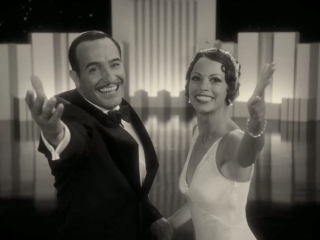
The Artist, in fact, I liked it. I just didn't love it and felt disappointed by it. It has plenty of good points. Its period details are wonderful. Beautiful. I can't imagine where they found all these 1920s-era buildings and cars. The costumes, too, are almost always spot on. The leads are incredible and full of personality and charm. Also, there are many lovely "art shots" where photography is used well to showcase something beautiful or striking. And in a few places, it
has some flashes of excellent visual storytelling. For instance, the pantomime Peppy does at the beginning with George's coat is fantastic. And the best scene in the film is the one when George's dog runs down the street to get a policeman when there is a fire. But the scenes with that kind of spark (forgive me) are few and far between.
The film, like others before it (
Singin' in the Rain,
Sunset Blvd.) lines up to make the point that those adhering to silence after sound became available were misguided dinosaurs who couldn't see the writing on the wall. But I detest that point of view. People who wanted to cling to silent film were
not just foolish old timers. They included people who could sense that something important and special was about to be gone for good. (Imagine how you would feel if they stopped making books). These films (
Sunset Blvd,
Singin' in the Rain, and now,
The Artist) oversimplify the silent to sound-era transition. In fact, at the time of this transition (the late 20s), silent films were significantly better, artistically speaking, than the sound of the time. Most sound films of this transition-era are garbage by today's standards, whereas some of its silent works still hold up incredibly well. It took many many years before sound films were as good and well-made as the ones Peppy (in The Artist) was seen to be making. While good silent film continued to be made and enjoyed for years after
The Jazz Singer. It was not a hard line immediate switch.
One of the best moments of
The Artist's silent storytelling comes at the end of the film when Peppy and George are dancing together in the director's office. Its wonderful. But just as the film has finally managed to speak successfully to the viewer without dialog, they yell "cut" and the film switches to sound. It is the moment that cements the lack of opportunity as it become just another film lauding the triumph of sound over silence.