Sunday, November 18, 2012

A Case for Silence


Visiting Hollywood with a few ten thousand others was not just far too colorful an experience, it was far too loud. But then I've observed that calm and peace do not seem to be things that many others seek.

After walking the Hollywood Walk of Fame, and though we dipped into just one attraction, my head was buzzing and my eyes were popping. By the time we drove away, I craved a real piece of history, not to mention a real piece of peace -- just some simple remembrances of the sleepy dusty town where people from an entirely different world used to peddle their craft.

A surprising note to our family's LA film history tour was the futile search for historical and cultural resources devoted to Hollywood's distant past. We realize that this is not a hot attraction for most people in the Entertainment Capital of the World, but with the billion or so people living on this stretch of coast, I admit I was hoping for a fairly large exhibit somewhere of early filmmaking memorabilia and resources.

If such a treasure trove is there, I never found it. I do understand that Los Angeles Natural History Museum has a small exhibit dedicated to early film pioneers but we didn't get there; we did try The Hollywood Museum, an oddity that bills itself as the place for early movie fans. Although they claim 10,000 artifacts, I'm pretty sure most of those are photographs. Worse still, desperate to compete for the least common denominator that flocks down Hollywood Blvd, they've taken a kitschy, cram-packed approach to old Hollywood that brought to mind the seedier aspects of the business - the focus on lifestyle, the desire to be more attractive at any cost, and the desperate search for fame.

However there is one place, just up the road from the big time, that contained a piece of what I sought and that we were lucky enough to find. Feeling a bit raggedy and exhausted as we left Hollywood Blvd, it's lucky enough that we didn't get into an accident on the way home--profoundly luckier still that we stumbled right past a wonderful little barn called the Hollywood Heritage Museum. The only fault with the place is that it wasn't bigger. They are on just the right track of preserving and discussing the history of the industry that came to California and took it over 100 years ago. Chatting with the well informed and pleasant staff, using indoor voices and dressed in reasonable clothes no less, I realized that there really are others like me -- probably dozens -- and that we should stage the comeback of silent pictures.

As the docent and I chatted, I thought about how the biggest stumbling block to people enjoying silence is a simple unfamiliarity with this style. But telling a story without audible words is not necessarily and absolutely a worse choice than telling it with. I mentioned The General as an example, he mentioned The Canadian, we both found that after watching these films and recollecting them later we couldn't quite remember their silence. They were simply so good that we didn't notice they didn't have dialog. We almost could have sworn there was sound because it was going on inside our imaginations. Hmmm... eerily reminiscent of the power of books, isn't it?

Silent film is no less a perfect form of storytelling, compared to sound movies, than reading books is compared to watching moving pictures.

The amazing thing is, I'm sure we're not the only ones who feel this way. Silence may never attract the masses again, but the internet is buzzing with people who love the art form -- connecting people who still harbor a blazing interest in the types of pictures so soundly drummed out of Hollywood when pictures started talking.

Although I'm willing to concede that in the late 1920s the technology of "sound on film" was a big advance, and an inevitable one at that with possibilities far beyond what film with only visuals could do, it is sad that it so obliterated what silent film could do well. Silent film isn't about the lack of sound. It is about fully filling the space in a film with story elements that are suited to a visual medium. It is not a less-than approach. It is a complete approach of its own. The acting is different. The camera movements are different. The way characters and scenes move is something that supplies direction to the story. After watching well-made silent films, I simply never have been known to say to myself: "that was great. I sure wish it could have had sound."

In an interview done in 1958 and accessible through Columbia University's Oral History Project, Buster Keaton talked about making visual comedies at the beginnings of the sound era:
I'm always going to find places in my story where dialogue is not called for.... You get those stretches in your picture of six, seven, eight, nine minutes where there isn't a word of dialogue. In those, we did our old routines. Then, when it was natural to talk, you talked. You didn't avoid it. But you lay out your material that way, it don't call for dialogue.... The minute sound came in, it was everybody talking their head off and going for dialogue laughs. All your writers did the same thing. Once that started, it took years to ever get anybody even to even touch that type of material again.... I tried every so often.
His words are profoundly true and sadly still not often hailed. This irrepressibly reminds me of Norma Desmond in Sunset Boulevard saying: "There was a time in this business when they had the eyes of the whole world. But that wasn't good enough for them. Oh no. They had to have the ears of the whole world too. So they opened their big mouths and out came talk talk talk!"

Filmmakers could be making the best of the media work for them now with slow moving, more visual stories that talk when its natural to talk, but they rarely do. Keaton continues in this interview to discuss how some of his movies were remade using sound by people who mistakingly thought that good material can be made better by throwing noise into it.  Here, he speaks of Red Skelton's version of The General:
They started that off with a battle scene, cavalry plowing over the hill towards the camera, guns going, flags waving, heavy music -- very heavy music. Everything. The minute that picture started, it come on with a fanfare and a blast, from the time the lion roared on the screen - this is an MGM picture - the blast was on. Now, we would go out of our way to see how quiet we could start a motion picture. In other words, I wanted an audience to sit back in their seats at the start and get comfortable. Not bring em up on the edge of their seats with the title and the opening scenes of the picture, but put them back in their seats. . . . while we planted the plot and the characters. Then we let that come. To this day, I can't talk a modern producer into seeing it from that angle.
And if Buster were still around I wonder if he'd still be futilely trying? Maybe the pendulum would have started swinging sooner, but it seems to me that it is slowly swinging now. Do you ever feel that you are on the verge, the cutting edge of a movement about to happen? A resurgence of silence seems almost possible. I've been reading a lot about Buster Keaton on the internet lately and I notice people say things like: "do you remember a couple of years ago when no one was talking about Keaton?" Now, go on to tumblr and type "Buster Keaton" in the search box and see how many pages come up.

Young people are starting to fight about who was better, Chaplin or Keaton. Silent film festivals are popping up all over the country. New dvds and blurays are getting issued all the time. And people are starting to talk about, er, not talking. For instance, Martin Scorsese's celebrated 2011 film Hugo presents a unique kind of story with an homage to silent film. A wonderful short, silent film, La Luna, got mass exposure playing before Disney's Brave in theaters last summer. And maybe even more exciting, for the time since 1929, and for only the second time ever, a silent picture (The Artist) won an Academy Award this year.

These films celebrate early cinema or practice a different, more subtle type of storytelling. I can only hope that more people will start paying attention to the beauty and peace of telling a story that isn't designed to bombard our senses and smash our intellects into submission. Films that are slower, more intelligent, that make you work just a bit harder and that make you feel proud to have viewed might not appeal to everyone. That's OK. I don't need them to take over the world. Just one tiny little corner of it again would be nice.

"Wonderful isn't it. And no dialog. We didn't need dialog. We had faces."
-Norma Desmond

Sunday, October 14, 2012

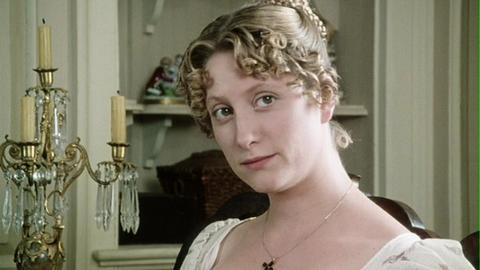
Susannah Harker as Jane

I love the 1995 Pride and Prejudice adaptation.  This is not an earth-shattering revelation. Many others do too. And I, like many others, watch it, oh, say, once or even twice a year.  -- whenever I am getting in the mood for fall. . . or looking for a way to unwind after being really busy . . . or snuggled in by a fire at Christmas. . . there are many excellent excuses to re-watch.

So re-watch I did. Again. For the umpteenth time and, as I often do, I reflected upon Susannah Harker as Jane. When I first saw this series, many many years ago, I remember that I was just ever so slightly disappointed with Jane, thinking, as others have done before me, that she is just not quite breathtaking enough for the role.  But each time I watch I see more and more of her beauty. You just have to look with the right eyes.

The problem is not Harker at all; it is her hair.

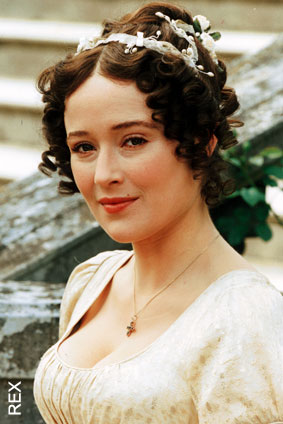
Now, this Pride and Prejudice was an authentic period piece, so I understand that they were constrained to Regency-era styles. Of course that would present some strictures as to what would be appropriate for Jane; but, it's just no excuse for her hair not to suit her face better.  Other women in the production have hairstyles that really fit both the actress and what her character needed to convey. Especially Lizzy. Jennifer Ehle looks just as Lizzy ought to, and in some scenes, her hair adds immeasureably to her charms - for example, the Netherfield Ball 'do.


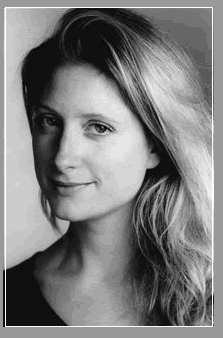
But poor Susanna Harker gets horns coming out of her temples. When she's casual, she gets to look long and stringy (with horns) and when she's dressed up, she gets to look too pulled back and severe (with horns.) The problem wouldn't amount to much except that Jane is supposed to be undeniably the most beautiful woman around and she comes off looking a bit unpleasant.  This is unfair, because on viewing photos of the actress not as Jane, I can see that she is very very lovely.


Here is how good Harker can look when she isn't becoming Jane:

She is very beautiful!

She has an excellent Greek nose, translucent skin and a lovely turn of the neck! While I admit that sometimes the production managed to showcase these characteristics well, for the most part, it failed to. The inability capitalize on and showcase the beauty of the character who was supposed to delight our eyes is one of the very few weak points in the production.

Thursday, July 12, 2012

Here's one you may not have heard of: Spy

Somewhere across the Atlantic a talented group of people is preparing to air the second season of a show that is obscure, strange and hard to find anything out about. Its likely to always remain strange but please, I hope, is on the road to the big time.

The show is "Spy," a deliciously smart and funny concoction, the brainchild of a really clever guy called Simeon Goulden who describes his idea for the show as follows: "well I think its about a nasty child and his single father. And I think the father maybe joins MI-5 by mistake."


The primer:
Tim Eliot is the main character, played by Darren Boyd. He is damn funny, dry and bumbling, yet with underlying intelligence and normalcy that makes you root for him in the crazy mixed-up life he's found himself in. Marcus his extremely irritating son. Marcus is supposed to be irritating, so I shouldn't find fault with him for that reason.

The high-tech spy stuff is a source of humor, such as when Tim enters headquarters and the recognition security doors never know who he is (mistaking him for women or inanimate objects) but letting him in anyway.

The spy boss, deliciously played by Robert Lyndsay (an ever-so-slight parody of Harry Pearce from Spooks?) is a hard-drinking, slightly out of touch man, in love with his power, a bit insane and generally inappropriate. He also is completely taken with Tim, though TIm disagrees with everything he says.

The rest of the cast is fabulously comedic and the writing top-notch, so that lines like these are not just funny but delivered with perfect timing:

Tim, trying to impress his coworker by acting very cool and walking in a cool way.
"Have you soiled yourself?"
"No. That's how men walk."
"Incontinent men, maybe."

Exchange between TIm and his co-worker Caitlyn upon whom he has a slight crush, when he finds himself at her place in a sketching class:
"Its a funny thing. When you were talking earlier about there being some nudity, I - I thought you meant . . ."
"Me?"
"You."
"Naked!? Get out a here What bit of what I said made you think that!"
"...uh, the words."


I can't wait for more like this. Though I'm sure I'll have to. I don't know when (nor if) the episodes will show up on Hulu. But I can tell you that last year's 6 episodes are all there for free and should be watched by lovers of great comedy. For those lucky enough to live somewhere that British shows are accessible in real time, you could watch the return of Spy tomorrow night (Friday the 13th. You don't think they did that on purpose do you?)

Tuesday, July 3, 2012

Anita, Andie and June Cleaver

Watching a melodrama parody from 1940 entitled "The Villain Still Pursued Her," I was struck with the beauty of the lead actress, Anita Louise. She was gorgeous in just the way that a modern audience was sure to appreciate. She had a look that struck me as reminiscent of someone I 'knew' well.

It was her mouth.

She had a lovely high cheeckboned sort of overbite that I could picture on someone . . . I knew I'd seen that unique mouth before. But where...


It took awhile, but then I knew it: Andie MacDowell! OK, I'm not saying they are lookalikes, but they do have the same "type" of mouth. I know it because I've always admired it on Andie. Its focused on the upper lip and upper teeth and seems to lead directly in to high, pronounced cheeckbones. Its the kind of look that makes her seem like she is always on the verge of saying the letter "F".


But then, the most interesting thing happened.

We've been watching "Leave it to Beaver" at our house lately. The show was playing this afternoon and I was noticing Barbara Billingsly, who played June Cleaver. Actually there are several things I've been noticing about June Cleaver that I missed the first time around. First, that she is very very thin; second that she is very very tall, and also that she is actually quite funny. But today I noticed something new: she has that mouth!

Maybe not quite as pronounced as Andie, but its there.

Look:

Wednesday, June 27, 2012

No dialog necessary here. Best Keaton's films are a treasure for modern audiences.

You must forgive my gushing about Buster Keaton. I do understand that this is not (technically) related to British television. But as I've said, the beauty of having your own blog is getting to write about whatever you want. ... And what I want right now is Buster Keaton. If you don't like that, I suggest you get your own blog  ; - )

My discovering Keaton is like discovering Cary Grant. I did the latter in my teens. How on earth did I get this far in life without knowing the incredible talents of the former!? His work is profoundly good and I feel compelled to spread the word. Any fan of quality film and tv, which you obviously are, should make a point of seeing his work. (Go on; go do that now. Try Youtube. I'll wait. On second thought, you'd best read the post first.)

To those who might not realize this, Keaton was not just a slapstick comedian of the silent age. He was a talented director who conceived and filmed original ideas in movies that are tight, well acted, beautifully photographed, subtle, and touching. Oh, yeah, they were funny too. They present such well-made stories, that even modern audiences raised on a barrage of color, sound, and special-effects will be won over. My younger son asked me a couple of days after watching The General, "mom, did that movie have sound; I can't remember?" A telling complement. The General is so exciting and so very watchable you don't even notice that it lacks dialog. Keaton's films are like that. Treasures for all time.

The four feature films that follow are my personal favorites and those I consider his best work.  They are quite distinct in their characters, plots, pacing and style. Yet they all bear the unmistakable stamp of Keaton. That "stamp," as I see it, is to make reality feel good. His films are rooted in real truths about the simplicity of plugging away through life, meeting challenges that arise, fighting, moving along. And accepting it all with eyes wide open and lots of humor. His world is not perfect by a long shot, but its never depressing -- because, he (through his wonderful characters) lives life so well. He is beautiful in the fullest sense of the world. And he makes me want to live my own life with more precision and grace - he makes me want to jump on things, bend backward, go do something! Buster inspires me and somehow makes me feel as if I could.

The General. 

Few will argue with this selection. It's the equivalent of saying that Imagine is John Lennon's best song. The General places on countless lists of 'the best movies of all time' and was one of the first films to be selected for preservation in the National Film Registry. Sadly, it did not garner such praise when released in 1926. Buster may have simply been ahead of his time, his adoring public appreciating him more in flat-out comedic roles, simpler of plot and less developed in theme. This movie is so much more than that.

Heralded as the next best depiction of the Civil War ever recorded second only to Matthew Brady's photographs, The General watches like a documentary, a comedy and an action adventure film rolled together. Layered over exciting scenes of Buster chasing down enemy soldiers who have stolen his engine (the 'General'), are a sweet story of love (for his girl and for the train) and a simple story of a man who rises to the occasion that duty calls for him.

Because the film was made so very long ago -- blurring our own sense of proper timeframe -- it is easy for the modern viewer to feel as if watching something authentic to its setting. That's remarkable. Especially given that it was not even done in the South, but in Oregon, which, by the way, provides stunning scenery even in black and white.

Against this gorgeous backdrop, Keaton spends most of the movie running... around, in, under and atop two civil war era steam trains. The trains are so enlivened by his clear love and attention that they become movie characters themselves. But the best character is of course Keaton's -- Johnny Grey, who spends the movie alternating between doing things that show incredible strength and skill, with things that feel pitiful. He walks a balance figuratively and literally that is astonishing. In one striking example, the renegades have thrown a long heavy wooden railroad tie onto the track to derail their pursuer. Keaton runs ahead of his train in an attempt to dislodge the tie. He manages to do so at the last moment, tugging it free and falling into the cow sweep.  With barely a moment to rest, he then sees another tie lodged halfway across the track just ahead. With precision that astounds, he heaves the first down onto the other hitting it like a see saw whereupon the whole thing springs to life and off the tracks -- not without nearly smacking him dead in the face first. The modern viewer has to know that shots such as this cannot have been 'faked' the way we are used to. Real logs. Real movie star. Real train. Moving. Real precision. Yet our hero conveys as much awkwardness as skill in having done it! takes it in stride and climbs back into the engine to stoke the fire before the next disaster. You can't help but love this man.

The stunts come fast and furious (including one so stunning it still shocks: the sight of the steam train "Texas" collapsing a burning bridge and plunging into the river below). Underlying the whole is a movie with so much heart that it makes yours ache. In one such scene, our hero has rescued his girl from the bandits and they are hiding out in the woods in the rain. Buster is kneeling on the wet ground next to her when she lays her head upon his chest and tells him he's brave. He puffs with pride and he cradles her to his breast with the look of utmost pleasure. You can feel his heart swell. Light fades and when morning dawns, it dawns on him sitting just there, having held that position all night - clearly unwilling to lose the moment. Only the subtlest attention is drawn to this, by him stretching out those bent legs in the morning.

Buster Keaton's uncanny way of underplaying a moment is his greatest charm. Like his choice to follow that tender declaration with a scene where he stuffs his love into a gunny sack to smuggle her out of enemy camp, and then steps on the sack several times before freeing her. Marion Mack, the actress who plays his love gives a great comic performance. She is game for this treatment and more and really gets to shine in the last half of the movie as she helps foil the bad guys, behave heroically and take her own pratfalls such as getting hilariously doused at a water spout.

The film hits it on all fours - everything a movie should be is wrapped up in one very beautiful package. It should be on any movie lovers 'must see' list.

Sherlock Jr.

The General may be the critical consensus for best, but my favorite Keaton movie is Sherlock Jr. (1924). Profoundly interesting and well made, Sherlock Jr. is simply unique. When you have a lot of experience watching movies (!) and are plumbing the depths of 90 year-old work, you just don't really expect that many surprises. But Sherlock Jr. surprises. It actually astounds.

Our hero is known simply as 'the Boy.' He's unskilled but confident. He works as a projectionist but dreams of being a detective. Keaton gives a great nuanced performance -- imbuing the Boy with dreams and longing, shyness, the desire to step up and be a man, and an overarching fear of failure. He's so timid with his girl that he can't look at her when he gives her a ring. But, he fearlessly tracks his suspect all around town when framed by his rival for the theft of a watch. In this production Keaton wears many hats very well (figuratively in this case.) In addition to the great acting he brings, Keaton the comedian is there, hilariously walking in lockstep with the suspect and performing clever vaudeville stunts. Keaton the director brings pacing, location, style and visual appeal. There are wonderful sweet details to the movie like having "the girl", played by Kathryn McGuire, actually solve the crime herself in a matter of minutes while Buster is out bumbling around. (I'm not going to climb too far out on a limb and claim him as an early feminist, but I do notice that in many of his films, the leading ladies are doing resourceful, intelligent and active things rather than sitting around waiting to be rescued. This makes me love him more.)

All these details come together to cause the film to feel complete and engaging, but the real punch is packed by its technological wonders. When the Boy gets back to his projector and starts the afternoon's show, he dozes off. Several amazing things start to happen. A hazy second-self wakes up, fractions off from the Boy, and walks away. He steps through the audience and orchestra and into the playing movie, with in-camera effects that are so well done that they look beautiful, convincing and evocative even in 2012.

What makes these scenes remarkable is not that Buster Keaton was able to achieve them, technically speaking, but that he was able to weave them, artfully, into a story where they actually matter. Sherlock Jr. is the antithesis of the early sound movies that used sound just to show that they could. These effects are central to the themes of reality, fantasy, dream and hero. When the Boy enters the picture and attempts to interact, he is expelled from the action. Another astonishing editing sequence shows Buster as the Boy in (quasi-)stationary position as the scenery in the movie continues to shift around him -- the background becoming a garden, a rocky outcrop, a jungle, a desert and a snow bank, etc. The effort involved in piecing together this nearly seamless sequence was massive. And it's beautiful work. But what makes it mind-blowing is that it is used to further the story. The viewer learns that the Boy doesn't belong in the movie, which moves mercilessly around him; he's not part of it. Not until he finds a role he can dream himself into, can Buster enter the movie. So when the bad guys on screen concoct their nefarious plot, Buster's sleeping Boy enters the action as the "crime crushing criminologist Sherlock Jr."  . . . As smooth, suave, Sherlock Jr., classy, well dressed, and smart, Buster gets to play an extremely attractive leading man. Its a delight to see.

At this point in the movie the technological thrills give way to ones that come from Buster's physical brilliance, starting with Sherlock shooting a deadly game of pool with stunning accuracy and managing to miss the ball that's been rigged with explosives. Or, my favorite, Buster riding on the handlebars of a motorcycle after the driver has been kicked off. Cars, puddles and men with shovels can't unseat him as he speeds along through the streets of LA and deftly past the still undeveloped hills of Southern California. While on the handlebars, he crosses a gaping bridge by riding across the tops of two trucks moving in opposite directions -- meeting up with them at the very moment that they align creating an insanely dangerous and transient bridge. Its impossible to overstate how well-orchestrated that stunt had to have been! [See my note in the comments below on this stunt]. I've noted before that these scenes play like James Bond (40 years ahead of schedule), so I was thrilled to hear, on the dvd version of the film I recently watched, that Bondesque music was playing in the background. Apparently I'm not the only one making that association.

The movie, at just 44 minutes, is a fast and furious ride. A great comic ending follows the joy ride when our hero reintegrates himself, reencounters his real-life lovely, and re-proposes -- taking his cues from the lead actor in the movie that is still chugging along on screen. Its a wonderful way to wrap the experience.

Steamboat Bill Jr.

This movie is the height, the absolute apex of charm. Pitting rough, river-rat dad and his dandy of a son whom he has not seen for years, Keaton has chosen a theme that has been subsequently and continually worked for laughs by many over the decades. Buster's endeavor in 1928 may not have been the first to attempt it, I don't know, but it certainly has to be one of the best.

Gruff dad, played beautifully by Ernest Torrence, does not do the best job masking his disappointment in how his son has turned out, but he tries to make the relationship work. That is, if by 'make it work' you mean 'force Bill Jr. into being a more suitable son.' Buster was put on this earth to play the role of Bill Canfield Jr.. He is perfection as the foppishly cute, childishly stubborn, but basically moldable son. He follows dutifully as dad pulls him along by the hand. He gamely lets dad call the shots on mustache- and ukulele- removal, as well as clothing and hair readjustment, but when he runs into his college girl friend (who unfortunately happens to be his dad's arch-rival's daughter), he draws the line. Buster's not giving up King's daughter (played deliciously by Marion Byron) and who can blame him; She is the cutest, spunkiest, gamest costar for Buster that I've ever seen. Her talents suit his extremely well and their scenes together are a joy.

The father/son pairing is extremely well done and forms the heart of the movie. The scene that has stolen my heart and that I cannot seem to watch enough times on Youtube, is one where dad takes Buster to get a new hat.  Buster immediately finds one he likes and tries it on for dad's approval. I love the way he thrusts his foot out and stands like a model displaying it. Dad casts it away instantly. Watch how Buster sneaks the hat back on for a try two more times (with no luck). Also watch how he secrets away his own hat into a back pocket when no one's looking. Buster's expressions while dad and the store clerk plunk a wide array of hats upon his head are priceless, but best of all is when the clerk tries a hat of Buster's Keaton's signature "porkpie" look and produces a priceless look of horror. Delightful and utterly self-aware. I love Buster Keaton.

Complications due to dad's underlying feud, disappointment with his son, and eventual jailing keep the plot humming along until the final 10 minute sequence which includes the most jaw-dropping barrage of nonstop stunts I've ever seen. No expense could have been spared during scenes of the town's destruction in a fierce tornado-like storm. The insanity culminates in the stunning scene where Keaton allows a house front to fall on top of him, just gliding over him by the slimmest of margins before crashing hard into the ground. From all accounts, this was entirely real -- with a several ton house front and a upper story window designed to give just inches of clearance around our main man. Buster could easily have been killed had anything gone awry.

Yet. . .  you feel safe watching Buster Keaton because his clear skill and precision allow you to know that he knew exactly what he was doing. Though he does death-defying stunts all the time, they don't feel scary or reckless because of his comedic touch and because of the trust the viewer develops for Buster. His physical skill just simply can't be praised enough. The man was a genius. The movie is a smile-fest throughout. Funny, sweet, physical and charming. Another perfect endeavor.

Go West

A love story about a man and a cow. That alone makes it one of the coolest movies ever.
Go West is not routinely included as one of his best, but it is. Here he matches the slower pace and tone of the movie to the work of a ranch and the heat of the desert.  The scenery and buildings are beautiful and we get to soak it all up at an appropriate pace. I don't want to overstate the point that maybe you have to love the desert to love this picture, but I think it helps. You gotta be able to see the beauty of the wood in the fence boards, the dusty wind, and the windows framing the shots of the hot grey mountains. Leave it to Buster to find both beauty and humor in this landscape.

Buster's character, "Friendless," is brave in unexpected ways. First, he installs himself on the ranch as a hand with no skills to recommend him and no real contributions to make. But he shows up for supper (though it isn't until his third attempt that he gets any food) and goes through the motions. He confronts a man who is cheating at poker and doesn't back down. He is plucky and willing and has the silliest little hand gun that belongs properly in a woman's purse. Getting tired of fishing it out of the depths of his holster when he needs it, he gets smart and attaches it to a watch chain.

I always have thought that you can tell a lot about a person by the way animals and children respond to them. Here we get to see Buster's soul through the eyes of an adoring cow. "Brown Eyes" is beautiful and her clear desire to be near Buster is evident. You have to trust the cow, given that she cannot have cared about the movie biz. ;)  (Another movie demonstrating Buster's winning ways with animals is The Camerman where the most amazing relationship develops between him and a little monkey. You can't fake that.)

Anyhow, there's a scene in Go West where Keaton is hiding behind a building watching the rancher approach his cow. As Buster crouches there, a slight wind picks up and kicks his hat off. He reaches out a hand and grabs it as it starts to blow away. He pops it back on his head almost without seeming to notice it has been blown. That in a nutshell is what's beautiful about Buster Keaton. The scene is small and serves almost no purpose. But these are the kinds of details you get with a Keaton movie. There are literally dozens of small perfect details packed into every  film. This one is special to me not just because its a small detail that shows his care and attention to the way his films came together, but because it symbolizes him in a nutshell. Its shows physical brilliance (lightning quick reflexes) and total unflappability. Life is going on in front of you and around you. Odd things happen. You just keep going. Don't worry about why. Though Buster is uber-present in the world, no one - least of all himself - sees his strength, balance, reflexes, and agility. His enormous eyes are always looking at the world with detached wonderment and interest. And together those eyes and his physical engagement make his trajectory through life fascinating, humorous and ultimately successful (in the broadest, non-sentimental way of living a well-lived life as being the only reason to wake up). But its only the audience who really sees.

His real genius seems to have escaped his contemporary audience. They loved his humor and made him a star, but his very best and most profound work was panned upon release. Buster was making his movies toward a deeper standard -- his own. I am incredibly grateful that he got to do it as long as he could and that I managed to stumble upon it.

Tuesday, June 12, 2012

The first great 'talkie,' It Happened One Night is a gem.

Its funny how when you begin to write reviews, you get plagued by cliche. Overused sayings just pop into your head of their own accord and you find yourself saying things like "this was a gem of a movie" or it was like "a breath of fresh air" before you know what you're doing. So, in that vein, last night's entry in the film fest, "It Happened One Night," was a little burst of fresh gemmy air - if you'll forgive the expression.

I always knew it was a good idea to work forward in time through classic movies, but now, excuse my vanity, I really see the genius behind the plan. Watching "It Happened One Night" after several weeks of experience with earlier films just blew us away . . . the way it should have. I can fully appreciate why this movie swept the Academy Awards and has gone down in history as the classic romantic comedy of all time, the first screwball comedy, a Frank Capra masterpiece and yet -- simultaneously had been the film NO ONE expected to succeed.

Most involved in the project seemed to think it was a crummy waste of time (Claudette Colbert, at the end of filming, famously told a friend: "I just finished the worst picture of my life;" Clark Gable was given the assignment as punishment). To explain the paradox, you have to set yourself in 1934 when movies just weren't like this. People couldn't easily see the value of doing something like watching two people travel along the countryside taking little quips at each other and falling in love. It must have been hard to picture, until it all came together.

Of course I realize that I'm not in a position to declare outright that 'nothing like this had ever been done before,' but I'll do it anyway. Feeling like an expert with over 20 titles prior to 1934's IHON under my belt, I can attest to this being a major leap forward in cinematic style. At this time in history the talkies were really just beginning to seize control of themselves. Prior to this, they were still heady with flagrantly flaunting the fact that they had sound, and hadn't quite figured out how to make the most of it. Many still moved and seemed like silent pictures - often bad ones - done out loud. It took a bit more evolution before movie makers could just work with sound, instead of struggle to make it work.

I'm certain to mess up the details here, so take this with a grain of salt, but early cinematic sound movies (starting with The Jazz Singer and others that came out in the next couple of years) used a phonograph process to separately capture the audio and a standard film camera to capture the video. The two were then linked together so they would play back in sync (a huge breakthrough for commercial viability). There were still many problems including the very loud motion picture cameras that had to be closed off in a soundproof box so that the sound recording wouldn't be fouled, to the fact that many theaters weren't "wired for sound," to the problems of skipping and syncing during playback, to wiring actors or locating them near large microphones that restricted their freedom of movement. And the problems led to reduced film picture quality. All adding up to these movies just not being up to snuff - artistically. It wasn't until the sound-on-film technology (in which the sound and pictures were simultaneously recorded, together -- and yes I realize that's redundant) that the art form could take off. Advances in all aspects of sound recording seemed to reinvent the medium and free up filmakers to think about making movies again and not just think about working with the new technology.

Back to IHON - here is a film that is perfectly positioned to swoop in with total understanding of the beauties of dialog, but not forgetting motion either. It is extremely effective at telling a story fully. Its silly, smart, well-acted, and seamlessly audible. It takes advantage of the full range of cinematic storytelling and probably had a huge effect on everything that came after. It "feels" noticeably more modern in its pace and themes than other movies we've watched. It had to have struck a perfect chord with audiences and critics.

Gable, in an atypical role, and Colbert have wonderful chemistry. Their chemistry and dialog carry the film. The cinematography is wonderful too -- lovingly portraying mostly exterior location shots (in great measure as a means of saving money on sets). The only time the movie slows down is near the end when a misunderstanding separates our leads and we lose their combined charm. Although the film is regarded as the genesis of the "screwball" style of comedy, other films that came later are more screwbally and probably better examples; this one may be better heralded as the birth of romantic comedy. One reviewer on IMDB made a point of noting that this is romantic comedy well before the genre became synonymous with "chick flick". Definitely not a chick flick, IHON relies on the talents of Gable --who is unquestionably a guy's guy -- to keep the film rougher and and just a bit gritty, very appealing to men. I can attest that all of the men at my house loved this film.

Now that we've entered the golden age of Hollywood cinema, I can't wait to see what the next one brings. Keep watching this space :)

Thursday, June 7, 2012

Notes from Buster Keaton's Newest Fan

I have been a die-hard Buster Keaton fan for almost a week.

My love of him first started at approximately 7:05 pm on June 1st. My knowledge of him began about 5 minutes earlier -- when I cued up "Sherlock Jr." on Netflix.  Prior to that time, I knew the name and had a notion of him being a film star of the silent era. Beyond that I knew nothing. Thank heavens that while doing research for our family's classic film project, I thought to include something he'd done to our list.
One brief exposure and I was hooked. Keaton grew on me quickly, and now I can't remember film without him. What strikes me most about the man, beyond his achingly interesting looks, is his extraordinary screen presence. Commentators use words like elegance and grace when describing his physicality. It isn't enough. He is almost supernormal in his ability to project a total ease and gentleness upon the things around him. He moves through space with a sweetness and light that I've simply never seen before.

This natural talent for poetry in motion is typified by Keaton's very first appearance onscreen in a movie called "The Butcher Boy." In his biography of Keaton, ("Buster Keaton: Tempest in a Flat Hat"), Edward McPherson shares the story. Keaton was taken to a Fatty Arbuckle movie set by a mutual friend one day, just to check it all out. The movie was filming and Fatty apparently asked Buster (who had tons of vaudeville and stage comedy experience but no prior experience with movies) if he'd like to appear on screen as an extra. Buster declined. Fatty stopped production for a bit in order to show his friend's buddy around the set and the ins and outs of what was going on; by the end of the tour, Buster had changed his mind and Fatty wrote him in to the production. (Gotta love how the movie biz worked back then.)

The film is cute enough and generally enjoyable, but Keaton steals the show - 6 minutes in with the simple act of tossing a broom. Buster walks in to the butcher shop, inexplicably picks up and inspects a broom from a barrel then tosses it to the ground; he picks up another, inspects it, then tosses this one back into the barrel. Only, those words can hardly describe the act -- how he seems to just invite that broom to sail sweetly back into the barrel on its own. Buster then walks over to the one on the floor and prods it with his foot, at which point the broom joins him in hand, then in barrel - without effort. The motion of those silly brooms and the simple but mesmerizing effect is bizarre. How can something like this be so riveting? I've watched the clip a half dozen times and I'm not sure. But it is apparent to any viewer that it is not all just a fluke because the next moment the broom routine is followed by the tasting of molasses. Which is even better. Yes that's it. Molasses. On shoe, finger, in mouth. Pure entertainment. Whatever star power is, this kid has it in droves.


If you're interested in Buster Keaton, check out the new blog What Would Buster Keaton Do. It features information and writing on his life and films.

Saturday, June 2, 2012

The Brilliant Harold Lloyd in "Safety Last!"

Roger Ebert says he is not 'brilliant' like Charlie Chaplin and Buster Keaton. Calls him an everyman who was successful through perseverance, not stunning talent. But I think someone who can still connect with viewers 89 years later has something pretty powerful going for him.

"Safety Last!", Harold Lloyd's masterpiece form 1923, has been my family's runaway favorite silent film so far in our series. From the opening scenes we were hooked, and continued to laugh aloud throughout.

Lloyd has a surprisingly modern quality to him. (Maybe this is underscored by the exceptionally well-preserved film. I understand that Harold Lloyd, unlike many other silent era producers, was meticulous about keeping his original prints stowed away safely). His face looks like one you would see today. Fresh, open, humorous, direct, ... not to mention good teeth.  He has a very charming, nerdish, appeal and a fantastic ability to express emotion with his face. (Hmmm... an olden days Jim Carey?)

He had our family in stitches with silly gags like avoiding his landlady who wanted rent, by, along with his roommate, stuffing their arms in their coat sleeves, hopping onto coat hooks and pulling their legs up and under.

The film is famous for Lloyd's stunning feat hanging from a clock on the side of a building. Someone, I forget who -- maybe it was that same Roger Ebert review (too lazy to check) -- said that this is a still-shot that everyone has seen, though almost no one has seen the movie from whence it came. More people should. It is great entertainment and a wonderful choice for dipping your first toe into silent film if that hasn't been your thing.

Although the film's value goes far beyond this iconic shot, the whole climbing up the building scene is simply fascinating. On many levels.

First, most basically, this is exceptionally entertaining comedy. Lloyd's character - through a series of silly setup moments - needs to do a stunt climb up the side of this skyscraper. I think they mention that it is 16 stories high. On the way up, he encounters children who accidentally drop popcorn on him, birds that torment him in order to get said popcorn, painters stuffing a plank out the window as he goes by, a mouse that climbs up his pant leg and a weathervane that has it in for him, not to mention the famous clock scene. (And, yes, from what I read online, this scene did inspire the clock tower dangling in "Back to the Future" and the new movie "Hugo" contains an homage as well).

Beyond the thrills of the plot, these climbing scenes -- give a perspective of historic downtown Los Angeles that is powerful. I am not steeped in that city's history, nor do I know these buildings and locations, but to anyone who is, this would be an enormous treat. An account of the filming, posted by the LA Conservancy, gives exact street locations and is worth sharing here.

Adding even more layers of interest, is the question any grown up watching is sure to ask them-self: "how did they do that!?" Apparently, there had been many decades of secrecy around the filming of these climbing scenes and that -- unlike in today's era where 'the making of' is actively plumbed for additional dramatic value and dvd special content -- it really was not well-known or discussed publicly. At least until many years later, and then there aere slightly conflicting accounts.  One thing that seems sure is that they were filming high in the air and that they were on location downtown in L.A. They apparently built a tower for the camera and a facade/set for the building being climbed. According to Lloyd himself, they built platforms below him and put mattresses on them! Lloyd never fell during this filming, though he states he almost did once. Although Lloyd did most of the climbing and tricks himself, a long-shot of the character seen at distance climbing a real building, was done by a guy they are calling "the Human Fly", Bill Strother, who plays Lloyd's funny roommate. Strother and his ability to scale buildings was apparently Lloyd's inspiration for making this film.

Maybe the most fascinating question and the final layer of interest is the "why" of it all. It is inconceivable to our modern minds for a major Hollywood picture to film anything that would put anyone - let alone our star! in such actual physical peril. The idea that the scenes unfolding in front of you are not, cannot have been computer enhanced in anyway, and although subject to 'tricks' of perspective and basic editing assistance, are an accurate depiction of people performing is heady. This lends an undeniable thrill to the experience. But what caused people to film actually dangerous things for our entertainment value? I guess, just simply, that they could. Still in in infancy as a medium, film makers were still working out what cinema was going to be, how it would be used to tell a story and what, if anything, was off-limits.

What I don't know about early Hollywood cinematic history could fill a blog, but I feel safe in saying that at this time in history there were at best minimal safety codes, controls on film content, and regulations on working conditions in place. What got made seems to be a function of what someone could dream up. The sky's the limit. Quite literally.

Maybe the reason that Harold Lloyd feels surprisingly fresh and relevant today is that he -- his style, his comedy -- was created for film. He was a product of the film industry, not a performer who imported his trade over to that medium from prior work on stage. He was inventing what worked on screen and his instincts were undeniably good.