I am talking about two Sherlocks that have probably NEVER been spoken of in the same breath by any human being before, but for each of which I've fallen.
It dawned on me recently that it was due to their roles as Sherlock Holmes that I initially became interested in two wildly different actors that I now consider among my all time favorites: Benedict Cumberbatch (as Sherlock) and Buster Keaton (as Sherlock Jr.) There are some odd similarities between these two stars and these two productions that caught my attention when I started reflecting. The oddest by far is that I've never considered myself a particular fan of the Sherlock Holmes character.


Don't worry, I'm not going to claim that these two are look-a-likes. I've taken some grief here on the blog for outlandish claims of look-a-likes in the past, so you know I'm not afraid to go out on a limb if warranted... but really I don't think even I would go there with Cumberbatch and Keaton. It's not so much that they look "alike", but I will argue for some shared characteristics.
First, and I guess quite obviously, these two actors have extraordinary eyes. Not alike, no. Benedict's are very pale, almond shaped, and almost Asian-lidded. Whereas Buster's are dark, round and very deep set. (And as I wrote that, I realized they have another interesting commonality -- a vagueness as to color. Benedict's eyes apparently change color, so I don't know what color to call them; and Buster was filmed in B&W, so "we" don't really know what color eyes he had.) But for both of them, it was those eyes that got me. Incredible, wide-set, in a pale smooth-skinned face. After watching Sherlock Jr. (with no intent of thinking about Keaton as any sort of a sex symbol, in fact with no intent of caring about him in the slightest), I found myself the next day continually visualizing that wide space on his forehead - that large, open, wide-eyed look. It stuck with me, and I couldn't wait to rewatch the film just to look at him again. Benedict's Sherlock grabbed me in much the same way, though it took a bit longer. I realized after watching a couple episodes that whenever I thought about him, my thoughts focused on 'space' -- that wide countenance. Both of them have this quality. And its obviously a quality I like. That openness, I think, lends an air of intelligence and inscrutability with a touch of wonder that mixes well with Sherlock's dispassion.
Another similarity for these two men is a thing that both Keaton and Cumberbatch are renowned for: their cheekbones. And that's a pretty odd parallel to be talking about considering I can't really think of another star I associate with cheekbones.

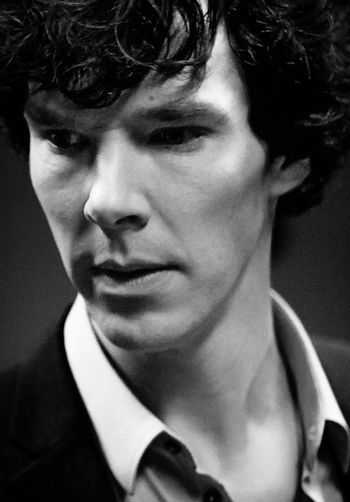
Their faces are quite different -- Buster's is more square-shaped, Benedict has a long face, but each has a deep chiseled profile that photographs stunningly. The profiles are manly and add greatly to the charm of these actors who are otherwise so smooth, open and white that there might almost be a hint of femininity about the features. Delicate in some ways, deeply rugged in another, these men share an appealing mix of qualities.
Cheekbones and eyes, pale open faces. Check. I guess I could talk about the manes of rich brown shaggy hair these two seem to enjoy, but why even go there, as it is a feature shared by a great many actors. (Though it is certainly pretty to look at). What strikes me in my musings though, goes way beyond these actors' interesting physicality, and deep into the productions themselves.
Consider the following:
I'll start with something that might seem mundane, but I find it really cool. Production length. I have never known a TV show that lasts an hour and a half. That's a weird length. Longer than a typical TV show, shorter than a typical movie for its genre, the creative forces behind Sherlock have chosen a unique timespan to tell their story in. I have often thought about what a brilliant length Sherlock is, and felt proud of the team for being willing to make a strong and unique choice in support of story.


But then it dawned on me -- and here's what most people reading this wouldn't know -- Keaton's Sherlock Jr. also has an unusual length (relative to 1920s era productions). Longer than a 'short', and short for a 'feature' film, Sherlock Jr runs 45 minutes. I have often considered the length of that production to weigh heavily in its favor and have recommended it to people by expressly noting that the pace and length are perfect for the story. Again, it was a genius choice to support the story with a pacing that feels crisp and allows the plot to unfold perfectly.
I think it takes a special kind of creative vision to say, "hey, here's what our story requires. We don't care if its an odd length. Make it work."

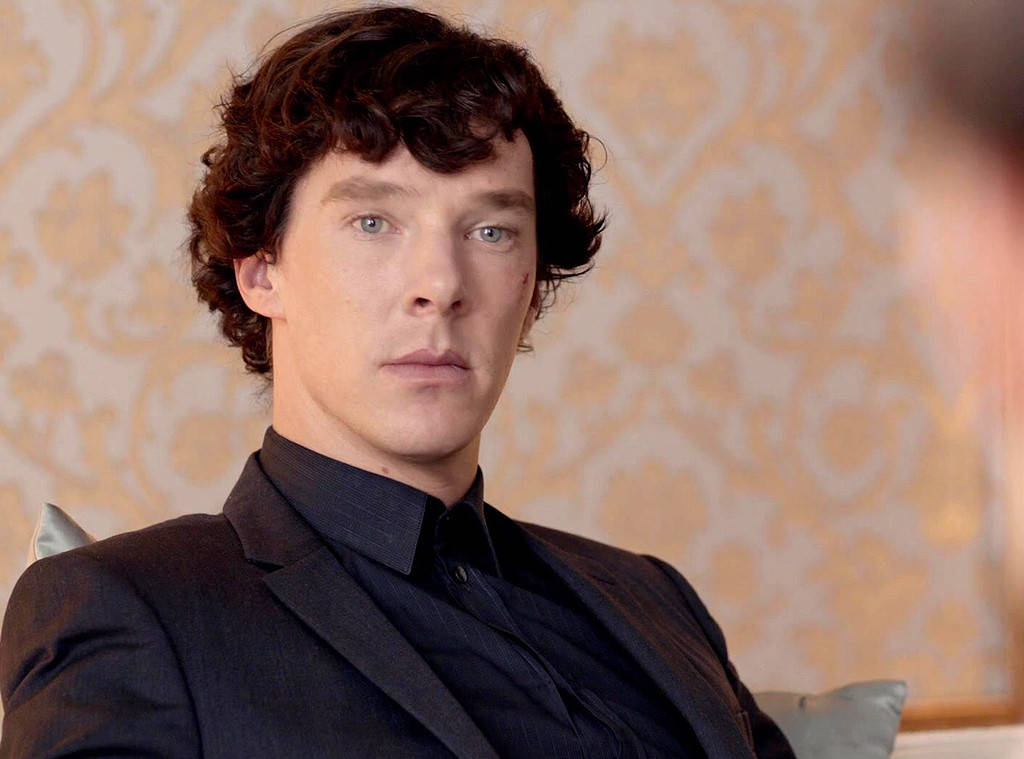 But there are yet other features that the two productions share. Each has taken a unusual twist on the Sherlock concept. In the TV series, the events have been set in modern times, while otherwise respecting the characters and plot and just translating them to the current world.
Buster Keaton's Sherlock Jr., made nearly 100 years ago, takes place in a "modern" world as well -- I mean, as opposed to Sir Arthur Conan Doyle's. Sherlock Jr. is only very lightly based on Holmes at all, using the character as a fantasy contrast to the mundane and sometimes painful foibles of our hero's life.
In nether production is there any attempt to go back in time and engage in period drama. Both simply roll some modern day sleuthing into a story of everyday life. In both these versions, the Sherlock character plays as someone very intellectual, in charge, and a bit distracted. Both have Sherlocks that feel very much a product of their times - rather than any past time. In Buster's version, his Sherlock plays pool, has explosives, engages in Vaudevillian tricks, rides around on a motorcycle and a boat, and cuts a stylish figure in dapper clothing. Its a very 20's-era piece. And Benedict's Sherlock is very 2010s production - with blogging, and cell phones, modern spying and forensic abilities.
But that's still not all.
Another thing these productions share: humor (blended with tension). Obviously, humor is what Buster Keaton is all about, but still, its pretty cool to see him working the spy genre for laughs. It may be more unique that the TV drama Sherlock is so unexpectedly hilarious. While Keaton's brand of humor is physical, the humor in the modern TV show is mostly verbal. That both productions are crazy-funny, is another similarity that marks these Sherlocks as unusual.
Finally, and maybe the coolest connecting thread may be that each of these two productions represent cutting-edge work for their use of clever photographic approaches to tell the story.
In Sherlock (the TV show), the production team uses very creative camerawork, special effects and editing, not just to impress us, but to directly move the story. A great Youtube video address this (How to Film Thought). The makers of this video are far more intelligent than I, but I am smart enough to know that what the Sherlock team manages all the time with extraordinary clever camerawork is part of what makes this series so very special. I highly recommend you clicking on the video here. Another trick that is used effectively throughout the TV series is thought-bubble-words to show what Sherlock is thinking when he is examining a crime scene or explaining his deductions. Rather than having to explain every last thing through dialog, the camera is used with great creative vision and a certain elegance that is integrated seamlessly into the artistic vision of the larger story.
But again, guess what? It's something that Buster Keaton did 90 years ago in Sherlock Jr.! A bit of background would probably help. In this film, Keaton plays a young man who works for a movie theater but dreams of being a detective. He wants to propose to his girlfriend, but his rival gets there first and mucks things up for Keaton, stealing her dad's watch and then planting evidence to make it look like Buster did it. Buster attempts to ply his detective skills and catch the guy, but fails, so he goes back to the movie theater, puts on a movie and falls asleep. What happen next is extraordinary: Keaton falls asleep and them dreams himself into the movie, where he materializes as the great detective brought in to solve a very similar crime of the stolen pearls. The scenes where his ghostlike sleepwalking self splinters off and walks into the picture are phenomenal. Even by modern standards, they are evocative and clever. Next, a montage of camera cuts where the background keeps changing while Keaton tries to find a place, are integral to showing us he doesn't really belong in that movie; he's an outsider living a fantasy. This movie within a movie allows us to explore themes of fantasy and the role of cinema magic that was taking such an important hold of people at this time and which clearly persist to this day. The fantastic camerawork is not just a showcase of technology, it is seamlessly integrated into story in an elegant way.
So there it is! Two Sherlocks, separated by nearly a century, separated by genre, by format, by audience, by intent and yet united by two tremendously compelling leads, and some amazing creative visionaries, willing to make bold and non-traditional choices for their creations. Though maybe not typically thought of in the same breath, both deserve exalted positions in the rankings of entertainment history.
Happy Viewing.


